
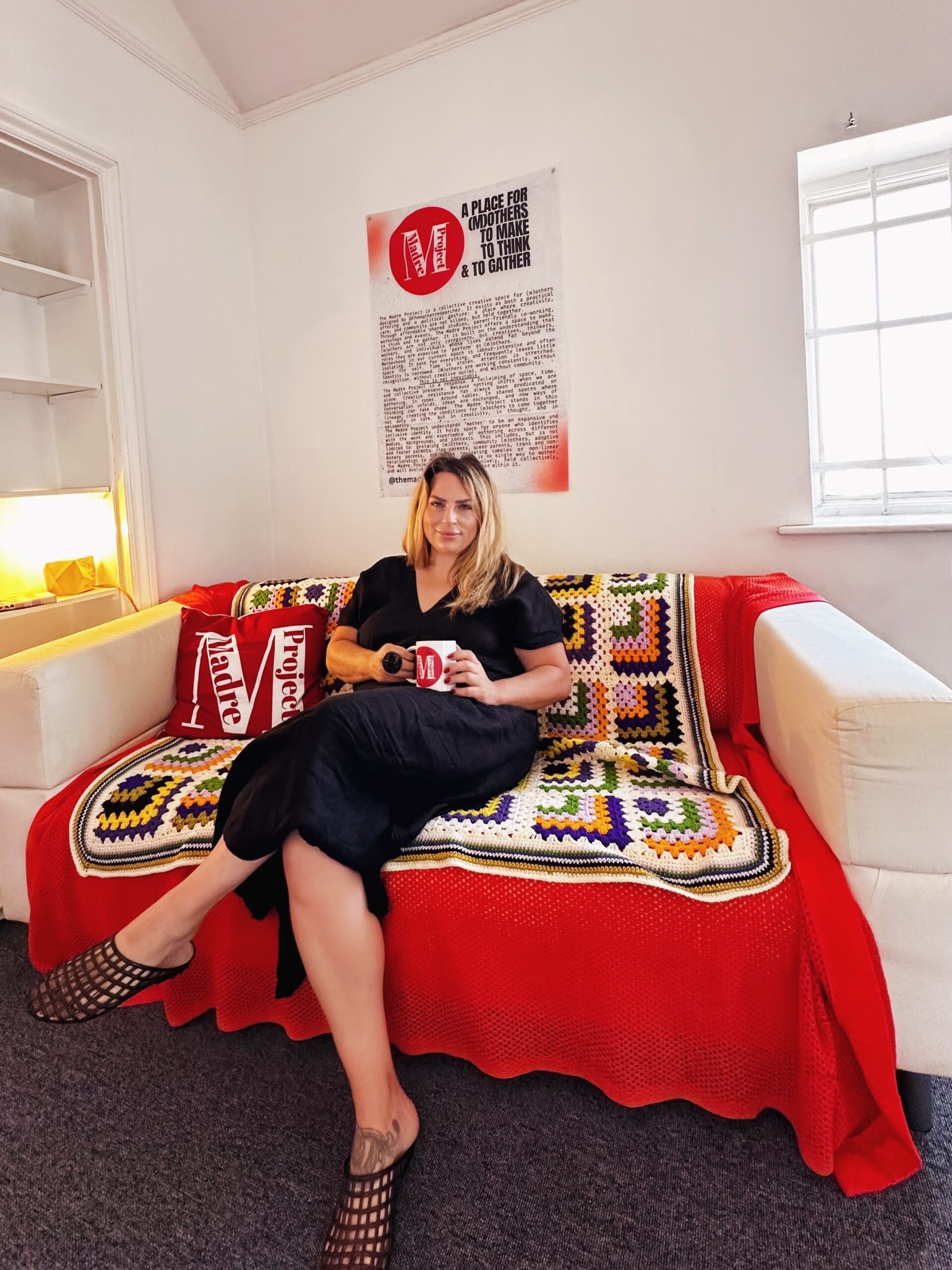
Sandy Oldaker is a PhD Researcher in Political Philosophy and Lecturer in Bioethics and Biopolitics at the University of Chichester. She has recently launched The Madre Project in Worthing, a shared studio, events space and community for (m)others (the couched (m) stressing inclusivity). Sandy’s research currently centres around the politics of reproductive labour and ethics of technological solutions to motherhood.
Tell us about your journey to University – what was the catalyst that made you realise Philosophy at University was for you?
There is no neat answer to this question, perhaps because my journey to university was anything but traditional. I was accepted to university at 18, but life had other plans. Instead, I built a successful career in sales and marketing in the city. From the outside, it looked as though everything was great, but behind the scenes I was navigating the realities of single motherhood while trying to sustain the demands of a high-pressure corporate career. Eventually, the relentless balancing act took a significant toll on both my physical and mental health. That period forced me to stop and ask what kind of life I wanted to build. For years, the idea of going to university had quietly remained in the background, but a dream I had never quite let go of. In 2016, in my thirties, I finally decided I could no longer ignore it. Leaving a secure career felt like an enormous leap of faith, but it also felt like choosing myself for the first time in a very long time.
I still remember the excitement of opening the email confirming that my application had been successful and that I would be starting university later that year. It was one of those rare moments when you know your life has changed direction. Although I didn’t know then that I would go on to build an academic career which now includes PhD research and lecturing undergraduates, I did know one thing: I had found a place where asking difficult questions was encouraged. The study of philosophy gave me the intellectual home I had long dreamt of.
What was your experience of University as a mature student and a single mother?
I think everyone’s experience of university is unique, but for me, finally having the opportunity to study made every day feel like a privilege. It certainly wasn’t easy. I was balancing lectures and assignments with the realities of being a single mother, managing childcare, paying the bills and trying to find enough hours in the day to do everything well. There were moments of exhaustion and many of self-doubt (thankfully I had a great supervisor cheering me on), and thankfully I never lost sight of why I was there.
One of the greatest transformations was in my confidence. When I arrived at university, I had no idea how to structure an academic essay, let alone imagine that I might one day pursue a PhD. With each assignment I began to find my voice. By my final year, I had discovered the thinkers and questions that fascinated me most and wrote my dissertation on the metaphysics of compassion. That dissertation was awarded the University’s Shirlea Lane Award for academic excellence, and I can honestly say it remains one of the proudest moments of my life. The award wasn’t simply recognition of the work itself; it represented the journey from wondering whether I belonged at university to discovering that I did.
What drew you to your area of research? Is there anything you can share about your lived experience that gives an insight into why you do this work?
In 2022, I approached my supervisor, Dr Tommy Lynch, with an idea for a PhD exploring the legacy of the feminist Wages for Housework campaign of the 1970s. I was fascinated by the campaign’s proposition: that the unpaid labour of motherhood and domestic work underpins our economic system, yet remains largely invisible and undervalued. My initial working title was Mother as Waged Worker or Machine?, the latter referring to the emerging possibility of artificial womb technologies, known as ectogenesis.
As a single mother, I had experienced first-hand the relentless labour of care and the ways in which it is taken for granted socially, politically and economically. I became increasingly interested in what philosophers call reproductive labour: the work of sustaining and reproducing life, and why it continues to be so profoundly undervalued despite being essential to society. While my research is academically rigorous, it is also deeply personal. I want to challenge the structures that continue to exploit reproductive labour and to ask difficult questions about the futures we are building.
Can you tell us a bit about your PhD thesis?
As I immersed myself in the literature, I became increasingly convinced that my research should centre on the phenomenon of ‘the motherhood penalty’, the economic, social and professional disadvantages that arise from the unequal distribution of reproductive labour. My thesis ultimately became: Addressing the Motherhood Penalty via a Technobiopolitics of Ectogenesis.
At its heart, the thesis argues that the motherhood penalty is not simply the result of individual choices or workplace discrimination, but a structural consequence of capitalism and neoliberalism. We are increasingly expected to become entrepreneurs of ourselves: continuously productive, efficient and self-optimising. The intensive labour of caring for children sits in direct tension with these expectations, making motherhood incompatible with the model of the ideal neoliberal worker. Alongside this drive towards optimisation is an increasing faith in technology as a means of solving complex social problems—a tendency often described as techno-solutionism. Rather than addressing the systemic inequalities that underpin reproductive labour, there is a growing risk that technological interventions become framed as the solution.
One striking example is the contrast between rising rates of maternal mortality on the one hand, and the celebration of technologies capable of gestating life outside the human body (ectogenesis) on the other. Rather than asking why pregnancy and motherhood continue to be organised in ways that disadvantage women, we increasingly ask how technology might eliminate the burdens of reproduction itself. Ultimately then, my thesis asks whether ectogenesis represents genuine reproductive liberation or whether it risks becoming a technobiopolitical response to a social problem that could instead be addressed through political and cultural transformation.
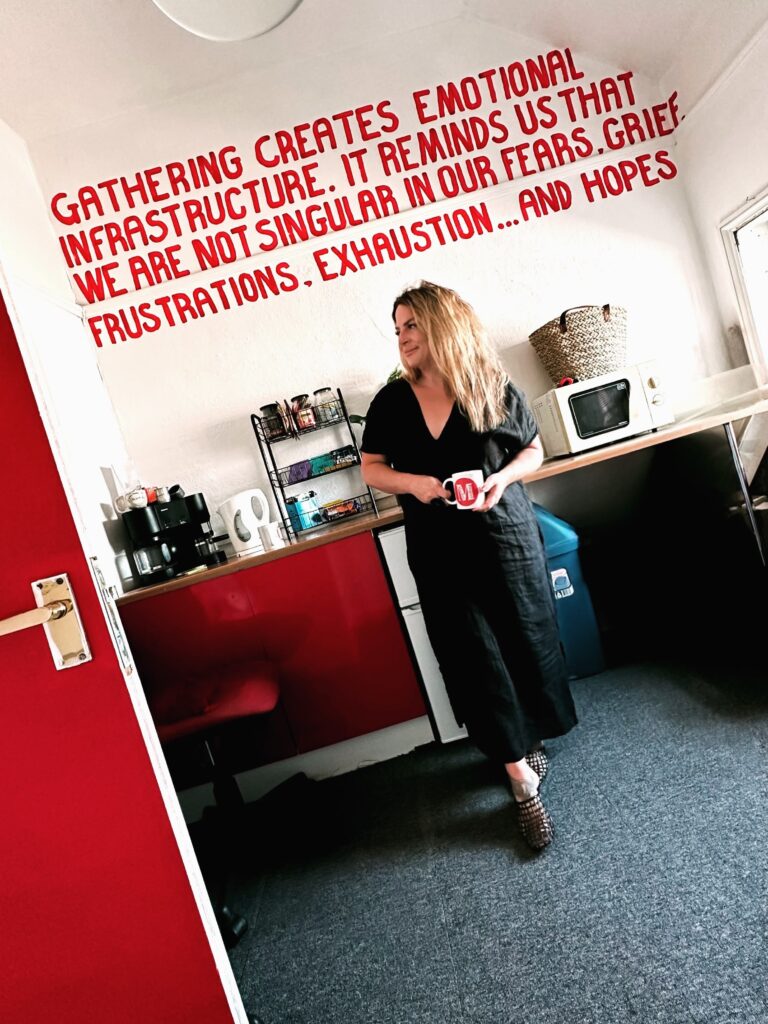
Tell us about The Madre Project and how your research has led you to opening this space?
The Madre Project is a nonprofit, bricks-and-mortar space in Worthing created for (m)others to make, think and gather. From the beginning, I saw it as both a practical offering and a political gesture: a way of challenging the conditions that too often leave mothers isolated, unsupported and invisible. The Madre Project is a space designed around the realities of care rather than expecting people to work around them. We offer below-market-rate, care-friendly studio and workspace, alongside workshops, gatherings and events that are both hybrid and Pay As You Can (PAYC), helping to reduce the financial and practical barriers that can prevent (m)others from accessing creative and intellectual spaces.
Opening The Madre Project is a leap of faith. I have committed to a three-year lease and embarked on this journey with the same uncertainty and hope that I carried when I first stepped into higher education a decade ago. That decision transformed my life, and I hope this one will create a space that transforms the lives of others too.
What would you say to mothers who are considering University but don’t believe it is for them?
I would ask where that limiting belief comes from? The demands of care are undoubtedly tough, but I always felt I deserved to invest in myself the same way that I invested in my children. On a practical level full-time study was possible for me as a mother, alongside part-time employment. A student loan covered my tuition fees and a maintenance loan helped with travel and study related costs. The university day usually compliments the school day, contact hours are usually spread over three days (depending on your course) and semesters are shorter than school terms. It’s certainly not as easy as it is for a school-leaver without dependents, but it is doable.
I suppose I would hope to inspire and say – “this journey has changed my life.”