
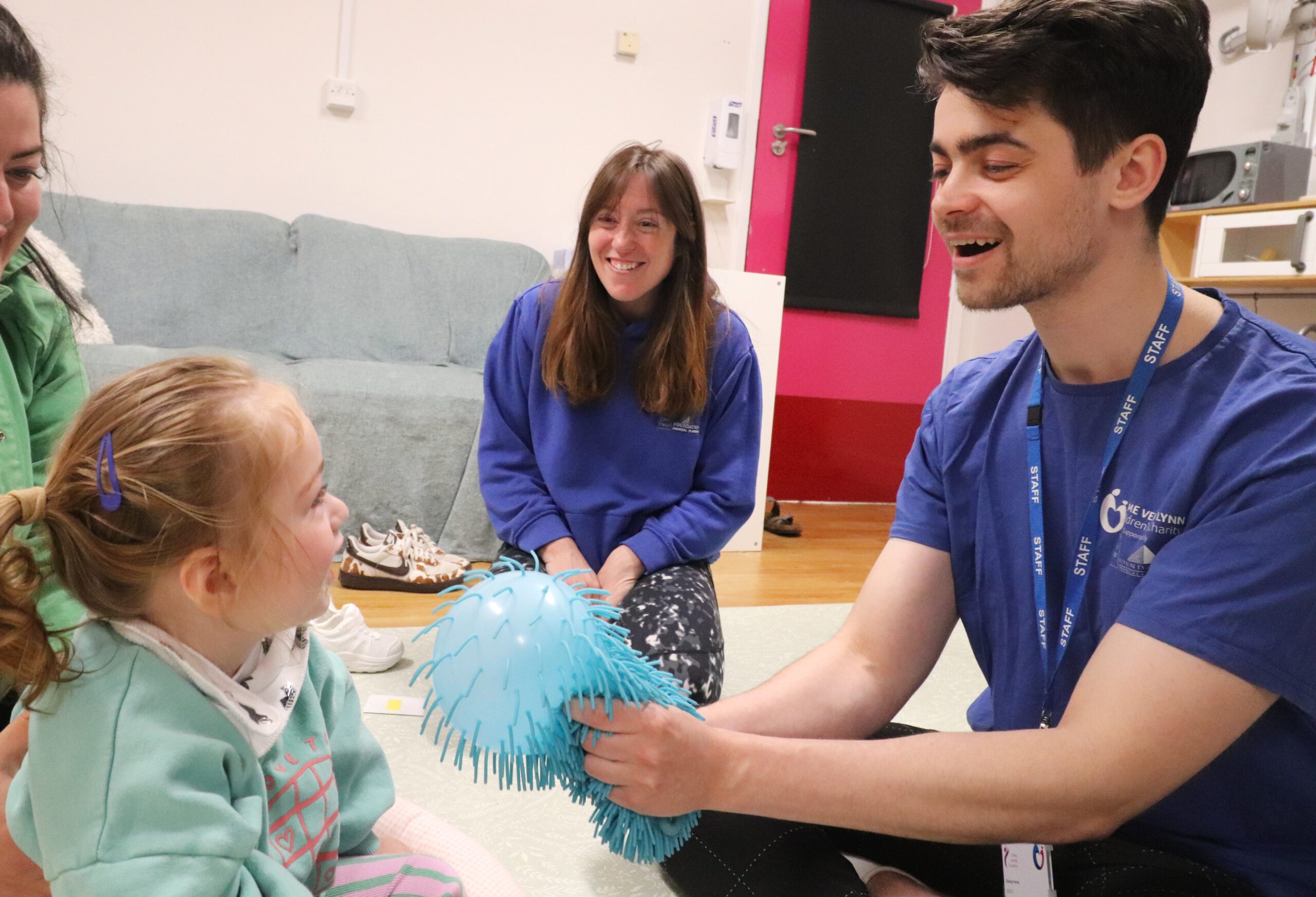
A partnership between the University of Chichester and Dame Vera Lynn Children’s Charity (DVLCC) has produced significant research findings in its first six months, highlighting the benefits of early intervention support for young children with neuromotor disabilities and their families.
The project, funded by UK Research and Innovation (UKRI), is now recruiting families with children under six who have a suspected or diagnosed neuromotor condition to take part in the next stage of research.
The University’s Dr Benjamin Sharpe, Senior Lecturer in Psychology, is working with the charity as part of a Knowledge Transfer Partnership (KTP), working closely with families and staff to understand how specialist early intervention services can improve outcomes for children and parents.
Dr Sharpe said: “The charity has spent years building something genuinely special for these families. Our role is to help tell that story with the rigour and evidence it deserves.”
One of the partnership’s first projects was to review existing research on early intervention for children under six with cerebral palsy, the largest group supported by DVLCC. The review found a lack of reliable tools for measuring family wellbeing and highlighted barriers that make it difficult for charities and researchers to gather evidence and advocate for families.
The team also analysed eight years of data from 111 children who completed the DVLCC programme. The findings showed significant improvements in children’s development across a range of areas, including movement, communication, cognitive skills, social skills, self-care and emotional wellbeing. The strongest improvements were seen in gross motor function and emotional wellbeing.
To better understand family experiences, researchers analysed case studies from the past decade. Four themes emerged:
- Families often arrived feeling overwhelmed and unsupported following difficult birth experiences.
- Parents valued DVLCC’s holistic and relationship-based approach.
- Children frequently achieved developmental progress beyond expectations.
- Families reported improved wellbeing, increased hope and a stronger sense of community.
Many parents described a clear difference between the support they received through DVLCC and that available elsewhere, highlighting the important role the charity plays alongside NHS services.
George Horne, KTP Associate at DVLCC, said: “These parent experiences reflect the stories of parents that I’ve met since working at the charity. Families across the UK desperately need more support and this project’s research output will help advocate for that.”
Professor Antonina Pereira, Executive Dean at the University of Chichester, said: “This partnership demonstrates how universities and charities can work together to address real-world challenges. By embedding researchers within organisations, we can generate evidence that is both academically robust and directly relevant to improving people’s lives.”
The next phase of the project will explore children’s development and parent wellbeing in greater depth, helping to build a stronger evidence base for early intervention services across the UK.
Families with a child under six who has a suspected or diagnosed neuromotor condition are invited to take part. Participation involves completing a survey, and eligible families who are not currently supported by the charity may receive a £20 thank-you payment.
To take part, visit: https://run.pavlovia.org/pavlovia/survey-2025.2.0/?surveyId=c353ba50-b768-4eea-8810-2140f1c805f8.