
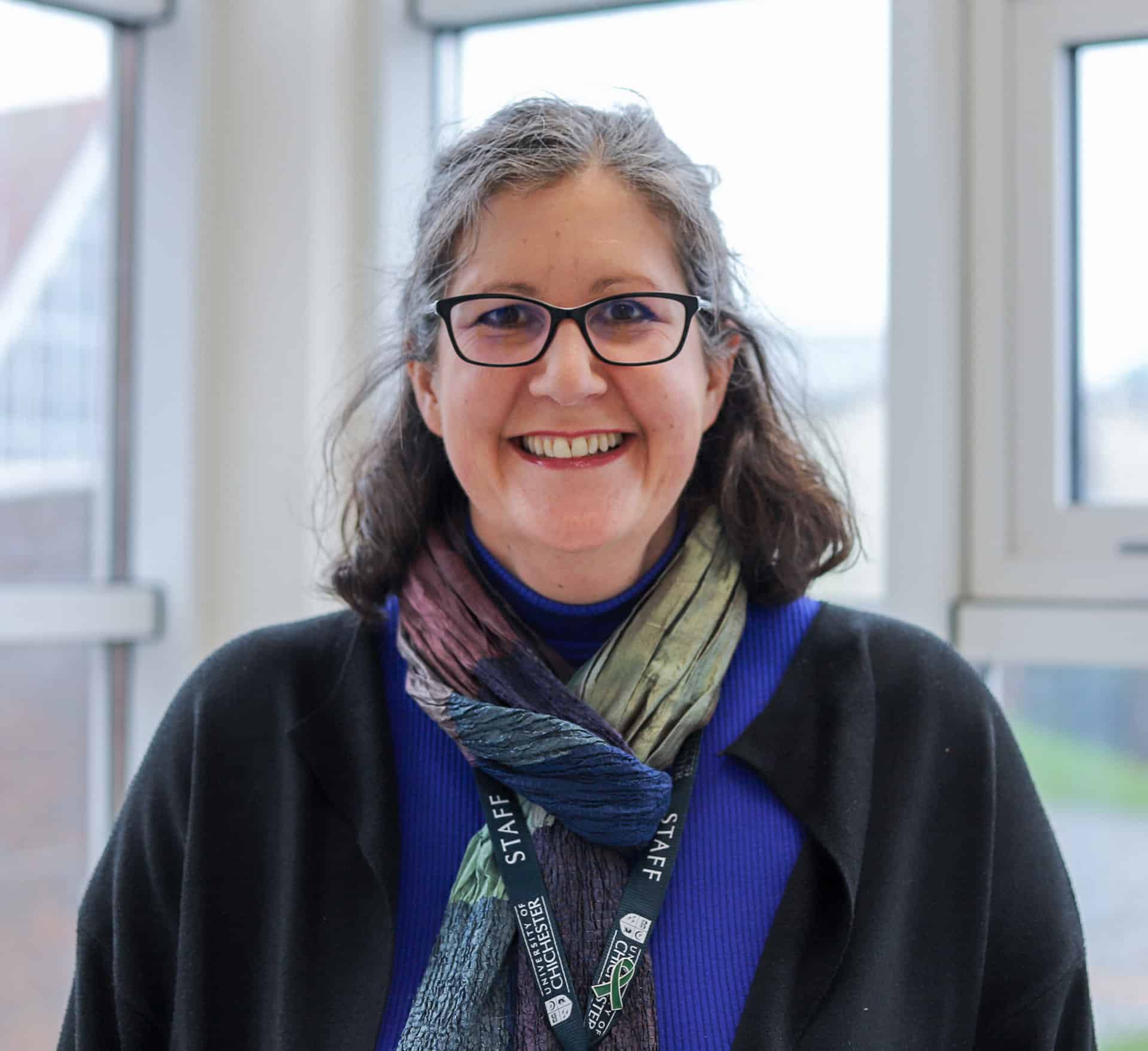
Kate Hicks, Lecturer in Psychology at the University of Chichester, shares her story of applying for university as a mature student through non-standard entry.
Kate left school after A-levels and went straight into full-time work, spending 30 years in senior leadership and operations across several major UK retailers, before deciding she needed a change.
“Although I genuinely enjoyed many aspects of leadership, particularly developing, coaching and supporting people, over time I began to feel increasingly burnt out and disillusioned with the corporate world,” she said.
Kate explained that supporting two close friends through terminal illness changed her perspective.
“After a lot of reflection, I realised I wanted the next chapter of my working life to feel more meaningful and more closely aligned with my values,” she added. “That ultimately led me to apply to university as a mature student in my mid-40s, a decision that completely changed the direction of my life.”
After looking at four universities within commuting difference, Kate said ‘Chichester stood out’.
“After I applied, the Head of Department contacted me to discuss my application. We had such a warm, encouraging and personal conversation that I immediately felt this was somewhere I would be supported to succeed. It wasn’t just another application; I felt like someone genuinely believed in my potential before I’d even started.”
And having the option to apply through non-standard entry ‘made all the difference’.
“Not only had I left education 30 years earlier, but I also didn’t have the minimum A-level entry requirements for the Psychology degree. At the time, the course required a science A-level, which I didn’t have, so applying through the standard admissions route simply wouldn’t have been possible.
“Instead, I was invited to have a conversation with a member of the academic team to discuss my background, motivations and suitability for the course. I was also asked to complete a short, written assessment exploring a couple of psychological theories. I remember feeling incredibly nervous when I submitted it, but I heard back very quickly with an offer.
“Being considered as a whole person, taking into account my professional experience, leadership skills, motivation and readiness to learn, rather than being defined by qualifications I’d gained decades earlier, opened a door that otherwise would have remained closed.
“It reminded me that learning doesn’t stop when you leave school, and that life experience has real value in higher education. I hope it encourages others who think they’ve ‘missed their chance’ to realise there are different routes into university, and that previous experiences can be just as important as traditional qualifications.”
Now Kate is part of the academic team at Chichester, and she said: “One of the most unexpected parts of my journey is that I now work at the University as a part-time Lecturer in Psychology while also completing my doctoral training in Counselling Psychology. Alongside this, I was fortunate enough to secure a role within the psychology team at my local hospice, which had been my goal from the moment I first applied to university.
“It’s incredibly rewarding to now encourage students who may be questioning whether they belong at university because I remember exactly what that felt like myself. In many ways, I’m still a student too, so I understand the challenges as well as the excitement of learning.”
On her advice for others considering University later in life, Kate said: “Remember it really is never too late. Many people think they need to have everything figured out before applying, but you really don’t. University is a place to explore ideas, discover strengths and create opportunities you may not even know exist yet.
“Your previous life experiences – whether from work, family life or other challenges, these aren’t something you leave behind. They become part of what you bring with you. Stay curious, ask questions, get involved in opportunities outside your course, and don’t underestimate how much you have to offer.
“If someone had told me ten years ago that I would leave a successful career to go to university, graduate with a First-Class Honours degree in Counselling Psychology, become a lecturer (the job I never knew I wanted), secure my dream role in hospice psychology, and be nearing the end of my doctoral training, I would never have believed them.
“Going to university later in life was one of the biggest decisions I’ve ever made, and without doubt one of the best. It completely changed the direction of my life, both personally and professionally.”
To find out more about applying to University as a mature student, visit: https://www.chi.ac.uk/student-life/support-health-wellbeing/mature-students/