
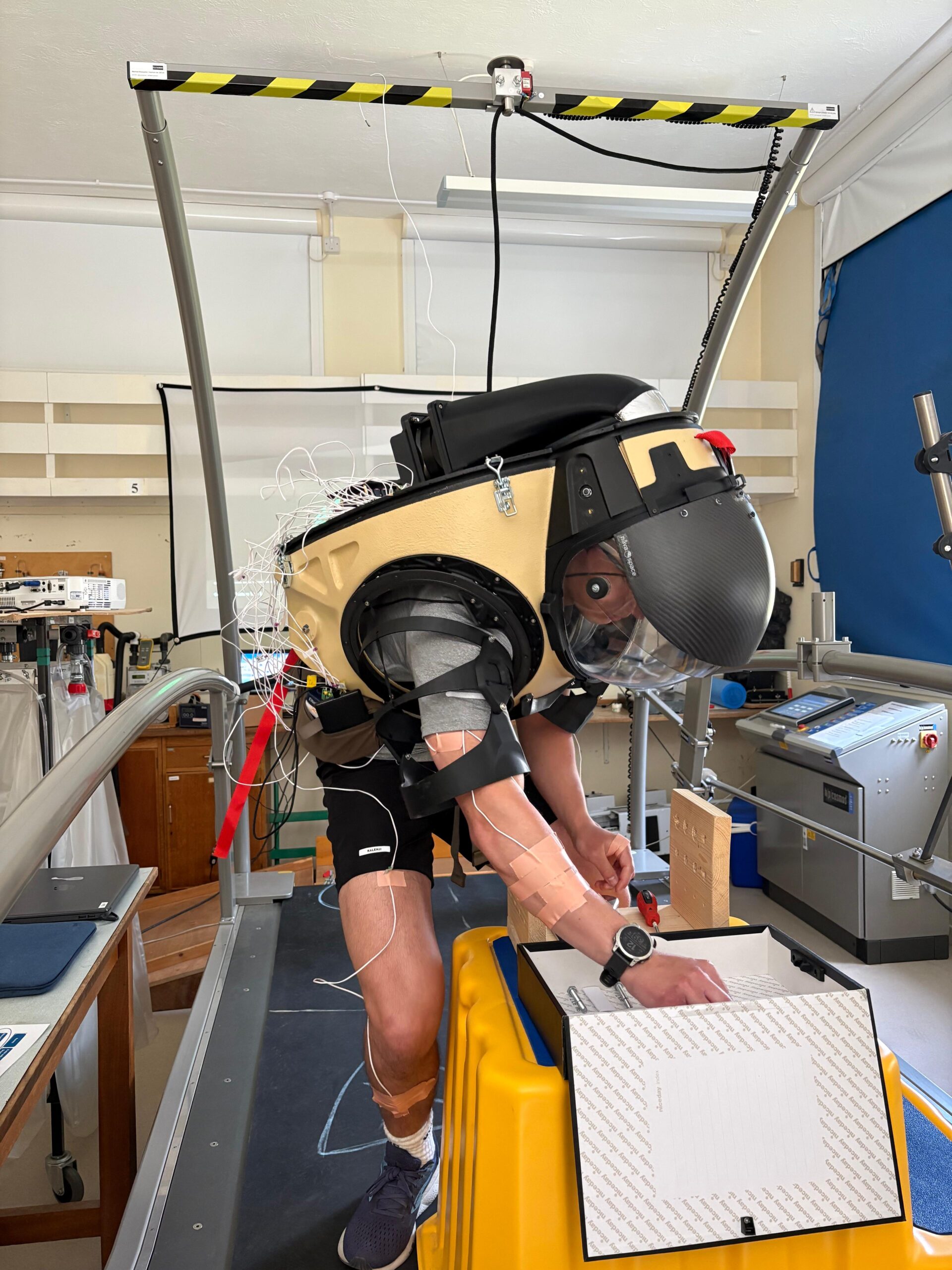
The University of Chichester has taken its first steps into out-of-this-world research in an international collaboration between its Occupational Performance Research Group (OPRG), King’s College London’s Spacesuit Physiology Laboratory, and Nåva Space. The project examines a prototype spacesuit for use in simulated lunar exploration tasks.
The project was designed with collaborators at King’s College London and focuses on an interdisciplinary experiment combining physiological measurements, cognitive assessments, perceptual sensations, and astronaut task completion to holistically evaluate performance during simulated extravehicular activities (EVAs).
EVAs include surface tasks that astronauts complete outside of a spacecraft, such as geological sampling, exploration and maintenance duties. This project builds the OPRG’s past success in designing and executing complex, interdisciplinary, occupational research.
Nåva Space’s prototype EVA suit was designed to enhance the wearer’s field of view beyond that of the current suits. Evidence of the suit’s ability to offer greater spatial awareness and reduced cognitive load must be tested through rigorous scientific assessments before development of the suit can progress. Therefore Marcus Peach (UoC), Kieran McAllen (King’s), Josep Martinez (King’s), Kaia Pilbeam (UoC), Christopher Vine (UoC), Oliver Runswick (King’s), and Jarle Steinberg (Nåva Space) put the prototype suit to the test.
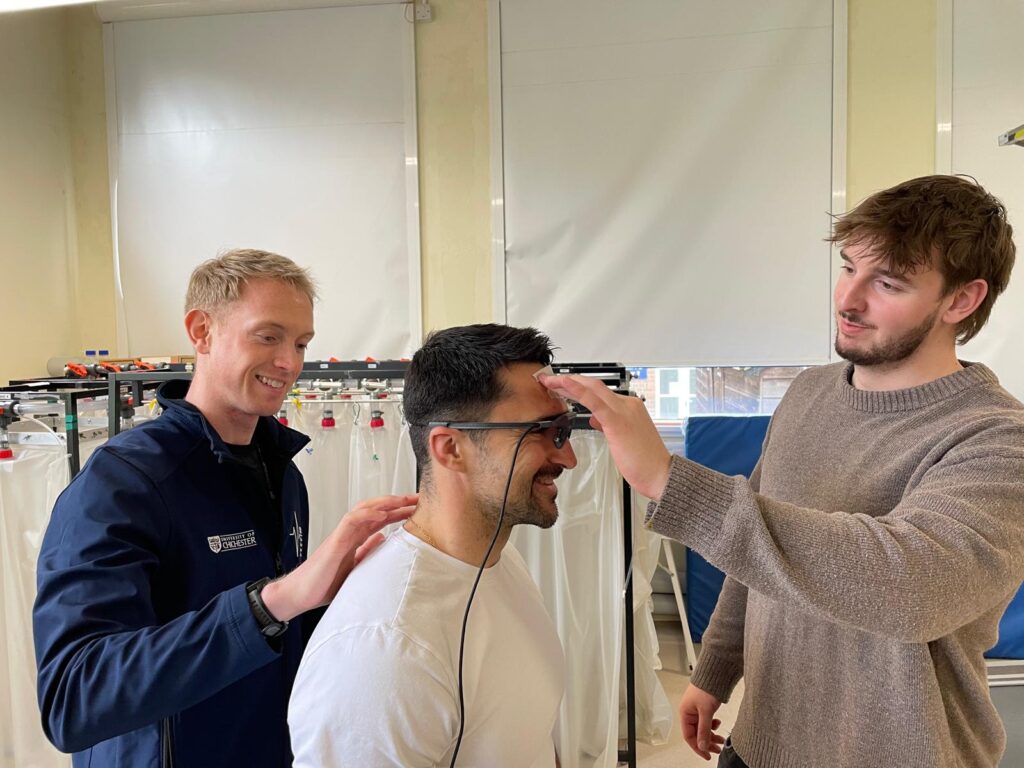
Referencing the project’s design, Marcus Peach, Data Collection Lead, said: “Space is arguably the most extreme environment that humans perform in, as even the smallest mistake, a stumble or a missed hazard, can have severe consequences to both mission success and astronaut safety. When we were designing this study, we knew from the outset that it had to combine physiological, cognitive, and occupational relevant aspects.”
The team assessed:
- Obstacle avoidance capabilities, simulating avoiding craters and rocks on the lunar surface during EVAs
- Visual identification of geological features, simulating one of the key roles of astronauts by searching for points of interest within a dynamic lunar scene
- Manual dexterity capacity, simulating construction of mission equipment and geological sampling
These cognitive and occupational metrics were combined with physiological variables (heart rate, skin temperature), biomechanical measurements (torso and head movement), and perceptual sensations (comfort of suit, mental and physical effort) during four distinct conditions that provided a detailed analysis on participants’ performance while wearing and not wearing the prototype suit.
Jarle Steinberg, CTO at Nåva Space, described the project’s context: “The lab study is establishing the groundwork for additional testing with space agencies and astronauts. The results from the Nåva Space development connect innovative concepts with cutting-edge, evidence-based science, leading to solutions for real-world problems.”
Describing their experiences with the project, Kieran said: “It was a big week of testing. It’s exciting to see psychophysiology in action in a simulated lunar EVA, learning so much about performance when the human and the system are treated as a single unit.”
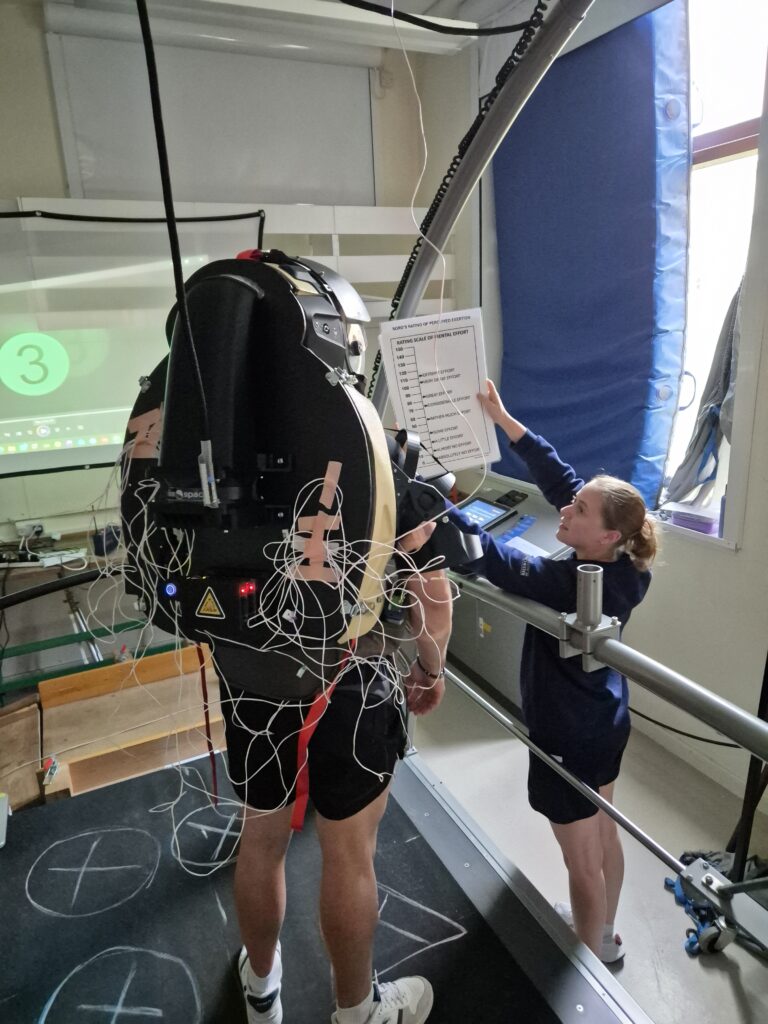
Josep Martinez, from King’s College London, added: “This project has broadened my knowledge through physiological and psychological research, complementing my background in aerospace engineering and deepening my understanding of human spaceflight. Collaborating with the University of Chichester and Nåva Space has also been an excellent opportunity to grow academically and professionally within an international and multidisciplinary team.”
This project offers an exceptional platform for staff and students across the University of Chichester, King’s College London, and Nåva Space to work side‑by‑side on a technically demanding and scientifically ambitious international study. The collaboration brings together complementary expertise, from occupational performance research and spacesuit physiology to aerospace innovation.
Beyond the immediate scientific outputs, the partnership has already begun to generate wider academic impact. Students from both universities have been invited to present methodologies and emerging findings at upcoming conferences, strengthening the visibility of early‑career researchers and showcasing the value of cross‑institutional teamwork. The OPRG and the King’s Spacesuit Laboratory continue to deepen their relationship, with joint plans to expand this line of inquiry and bring further space‑focused research activity to Chichester. This marks not only the first step in a long‑term collaboration, but a significant milestone in establishing the region as a growing hub for applied space physiology and human performance research.
OPRG’s Co-lead Professor Sam Blacker said: “This project was coordinated by Dr Chrisopher Vine from OPRG who has established our relationship with the SPL [King’s Spacesuit Laboratory] at King’s to enable us to undertake this innovative interdisciplinary research. This builds on our existing work to improve health and performance in physically demanding occupations. We are looking forward to working on future projects together with the SPL to better understand the physical, psychological and social aspects of health and performance.”