
Overview
Earn as you learn to become a Registered Adult Nurse
Important
Applicants for this course are recruited directly by employers, or are already employed by the NHS, private or voluntary organisation.
This course prepares you for future employment as a registered adult nurse, as you learn at university alongside working as a nursing associate within your employed organisation.
Finding an employer
Various local employers advertise these roles. You may want to contact healthcare organisations you’re interested in working with to check if they are hiring for roles that would lead to an apprenticeship. You can find live NHS apprenticeship vacancies here.
On this course, you will:
- Learn how to deliver the most appropriate, evidence-based care for patients.
- Become a resilient, attentive and compassionate professional.
- Graduate ready to enhance the quality of person-centred care.
- Develop a strong, professional network that strengthens your career opportunities.
- Gain elevated digital skills to prepare you for a rapidly evolving health and social care sector.
- Engage in annual inter-professional conferences.
Study on a nationally-accredited course
This course is accredited against the Nursing & Midwifery Council’s (NMC) 2018 standards, enabling you to be eligible to seek admission to part 1 (Adult) of the NMC register on successful completion of this three-year programme.
The NMC has assessed the course as requiring no improvements against 2018 standards, which is an exceptional outcome. This means you can be confident that you will be gaining the required level of theoretical and clinical training to succeed as a graduate nurse.
Develop your person-centred approach
You will learn how to observe patients and assess their needs to plan and deliver the most appropriate care for them and evaluate the results.
We will support you in becoming a caring and compassionate professional who delivers skilled, evidence-based care in partnership with patients, families and communities.
Benefit from excellent levels of support
Our commitment to small class sizes coupled with our team of empathetic and experienced teaching staff ensure that all learners benefit from elevated levels of excellent academic and personal support.
Any additional learning needs are identified early to ensure that specific support is put in place, and we provide dedicated sessions for those with neuro-divergency.
Experiential learning through cutting-edge technology
Our innovative facilities enables you to experience creative teaching methods and real-life immersive learning experience through recreated case studies that utilise robotic mannequins, augmented reality in our immersive room and actors.
Staff in the school are experts in this field with published research in simulation-based learning.
Facilities include:
- Immersive sensory simulation space
- Virtual reality equipment
- Six-bed clinical practice area
- Responsive robotic mannequins
A rich history of nursing education
In 1973, the 25-year-old Graylingwell School of Nursing combined with Royal West Sussex and St Richard’s Hospital School of Nursing to form Chichester and Graylingwell School of Nursing, which was responsible for most nurses who practiced in the area before it closed in 1978.
The School of Nursing and Allied Health at the University of Chichester now takes up the mantle to promote and develop nurse education in the local area.
The Course
Learn through a combination of theory, simulation, practical sessions, placements and work-based learning
The course has a 50/50 split between theory and practice activity across both University teaching and learning with your employer or via external placements. Each year of the programme is constructed with blocks of theory and blocks of clinical practice.
You will be required to complete a total of 2300 hours of practice and 2300 hours of theory to register as an Adult Nurse with the NMC. You will be able to offset 1150 hours of theory and 1150 hours of clinical practice by evidencing these during your application of recognition of prior learning (FdSc Nursing Associate award).
Throughout the two years of the course, you will undertake placements at local healthcare institutions to provide you with the required level of experience and knowledge for a registered nurse. You will also continue your substantive work as a Nursing Associate during theory blocks and work weeks.
Your on-campus studies to help you learn and develop as a professional nurse.
Study areas include:
- Caring sciences
- Person-centred care
- Professional issues
- Health and wellbeing
- Mental and physical health conditions
- Preparing for practice learning.
Year One
Your first year aims to develop your caring science knowledge and practical clinical skills, as you expand your understanding of clinical decision making in response to those who need end of life care and complex multi-morbidities.
You will also explore the subject of pharmacology and its applications within nursing, as you develop your ability to work within a healthcare team dynamic.
Year Two
In your second year, you will develop your understanding of person-centred care in relation to those with complex needs and adult patient deterioration. In addition, you will explore the delivery of effective nursing leadership and policy development.
Your final year also sees you focus on working across healthcare systems and develop your leadership and management skills.
Recognition of Prior Learning (RPL)
To recognise your FdSc Nursing Associate qualification, you will not be required to complete all Level 5 modules suggested below. The NMC states that you can RPL 50% of your total required credits for a programme, including 50% of the clinical practice and theory hours. The modules you will complete at Level 5 will be determined during your application process with a member of the academic team.
Indicative modules
The following list is indicative and subject to future change.
Year One
- Preparation for Practice – Year 2
- Understanding Illness for Nursing
- Developing as a Professional Nurse
- Delivering Person-Centred Care
- Caring Science in Population Health
- Caring Science: An Understanding of Evidence-Base for Holistic Nursing Practice
Year Two
- Preparation for Practice – Year 3
- Being a Professional Nurse
- Maintaining Person-Centred Care
- Caring Science for Quality Improvement
- Health Numeracy
Teaching and Assessment
Feel the support of our expert and experienced staff
Collaborative learning
You will experience a range of different techniques such as enquiry-based learning groups, blended learning, keynote lectures and small group seminars.
Our innovative and supportive teaching approach is based on a collaborative learning philosophy, which encourages you to learn with and from other and achieve your own learning goals.
Smaller class sizes for better support
Our dedication to smaller class sizes means that our team of expert academic staff get to know you and your needs as an individual.
You will attend classes including lectures, seminars, interprofessional learning, workshops, practical sessions and simulations. You will work collaboratively with other students on the course as well as having service user and carer input.
Learning through work is a recognised learning activity, there will also be dedicated time for you to drive your learning through independent learning and reflection.
Experiential learning
From clinical practice settings to recreations of community nursing settings, our use of modern, highly-equipped simulation environments and situations combined with our simulated-based approach to learning develops your professional practice skills and your confidence ahead of your clinical placements.
You will have the chance to simulate various clinical situations with both actors and real service users in care.
Digital competency
We will work with you to develop your digital competencies across the three years as you utilise a range of technologies which will support your learning both now and in your future career.
We are exploring new technologies constantly and you will be exposed to virtual learning environments that recreate clinical scenarios, in addition to using an online learning practice portfolio and developing your own vlog.
Varied assessment methods
Your placements are assessed through an electronic portfolio, alongside more traditional forms of assessment for your clinical learning. Half of these are completed in practical sessions and can include presentations, essays, case-study analyses and multiple-choice exam questions.
Meet our teaching staff
You’ll be taught by academics, with many who are registered practitioners from a variety of clinical backgrounds. Healthcare qualifying degrees offer a range of options for future employment both internationally and nationally. Roles can be within emergency care, primary care, end-of-life care and development into becoming advanced practitioners.
End Point Assessment:
The End-Point Assessment (EPA) is the final assessment and is integrated within this course. The apprenticeship assessment must ensure:
employers have confidence that the apprentice has reached the expected performance standard
apprentices are sufficiently secure in their knowledge and skills, so that they could demonstrate their competence in different contexts (for example, a different workplace)
Facilities
Experience brand new on-campus facilities that help you thrive
School of Nursing and Allied Health
The School of Nursing and Allied Health is based on the Bishop Otter campus. You will learn both on campus and in a variety of practice and simulation settings.
All learning will be supported by our lecturers in a safe and controlled setting, and by your practice assessors and supervisors in health and social care environments.
Immersive sensory learning technologies
Explore our immersive learning room that recreates sounds and visuals from a range of clinical settings, supported with the latest virtual reality technologies.
Health One building tour
Watch our virtual tour of our specialist Nursing facilities within our dedicated Health One building located on our Bishop Otter campus.
Bishop Otter campus
Watch our virtual tour of our historic Bishop Otter campus in the heart of Chichester, complete with our newly-developed HealthOne building.
Six-bed ward environment
Our six-bed ward environment recreates a hospital setting, allowing you to practice basic nursing skills in a realistic simulated setting.
Robotic mannequins
Our responsive robotic mannequins allow you to simulate a variety of clinical procedures and situations ahead of your placement experiences.
Immersive sensory learning technologies
Experience our immersive learning room that recreates sounds and visuals from a range of clinical settings, supported with the latest virtual reality technologies.
Simulated community nursing settings
Practice your communication skills and managing difficult situations via Forum theatre and with actors in our community flat and GP surgery.
Expert and supportive staff
Our experienced teaching staff include clinicians in practice and are here to support you as you develop into a competent graduate nurse.
Specialist library facilities
You will have access to additional resources available from our partners who support your practice learning, including the specialist library facilities at the local St Richard’s Hospital.
Develop your digital competency
Gain critical experience of digital materials such as clinicalskills.net, Electronic Practice Assessment Documents and anatomical software with Hololens technology.
Learning and social hub spaces
Our commitment to a friendly and inclusive student community includes dedicated learning and social spaces within our HealthOne building.
Learning Resource Centre
The Learning Resource Centre (LRC) contains the library, a café, IT/teaching rooms and the Support and Information Zone (SIZ).
Work Placements
Transfer the theory into real life practice
Gain vital practice experience
You will also undertake four external placements over the two years which the University and your employer will base on your learning needs and proficiencies, each one lasting for six weeks.
These placements range across a variety of clinical settings to ensure you experience all fields of nursing, a variety of clinical settings and the range of hours expected of registered nursing associates.
Placement Allocation
Whilst placement allocation is based on availability across the sector, it is non-negotiable as they are allocated to ensure that you can have exposure to the relevant fields of nursing and clinical areas. Consideration of your home address and travel required is taken into account during placement allocation.
Additional Placement Options
There is an option for you to arrange bespoke placement days to enable you to experience areas of particular interest or that you feel you have not had exposure to during your course. These are arranged in discussion with your Practice Assessor and Academic Assessor.
Expect to:
- Attend across the seven day week 24/7
- Travel up to 90 minutes one way to placement
- Work in a range of clinical settings i.e., at home, in community and at hospital.
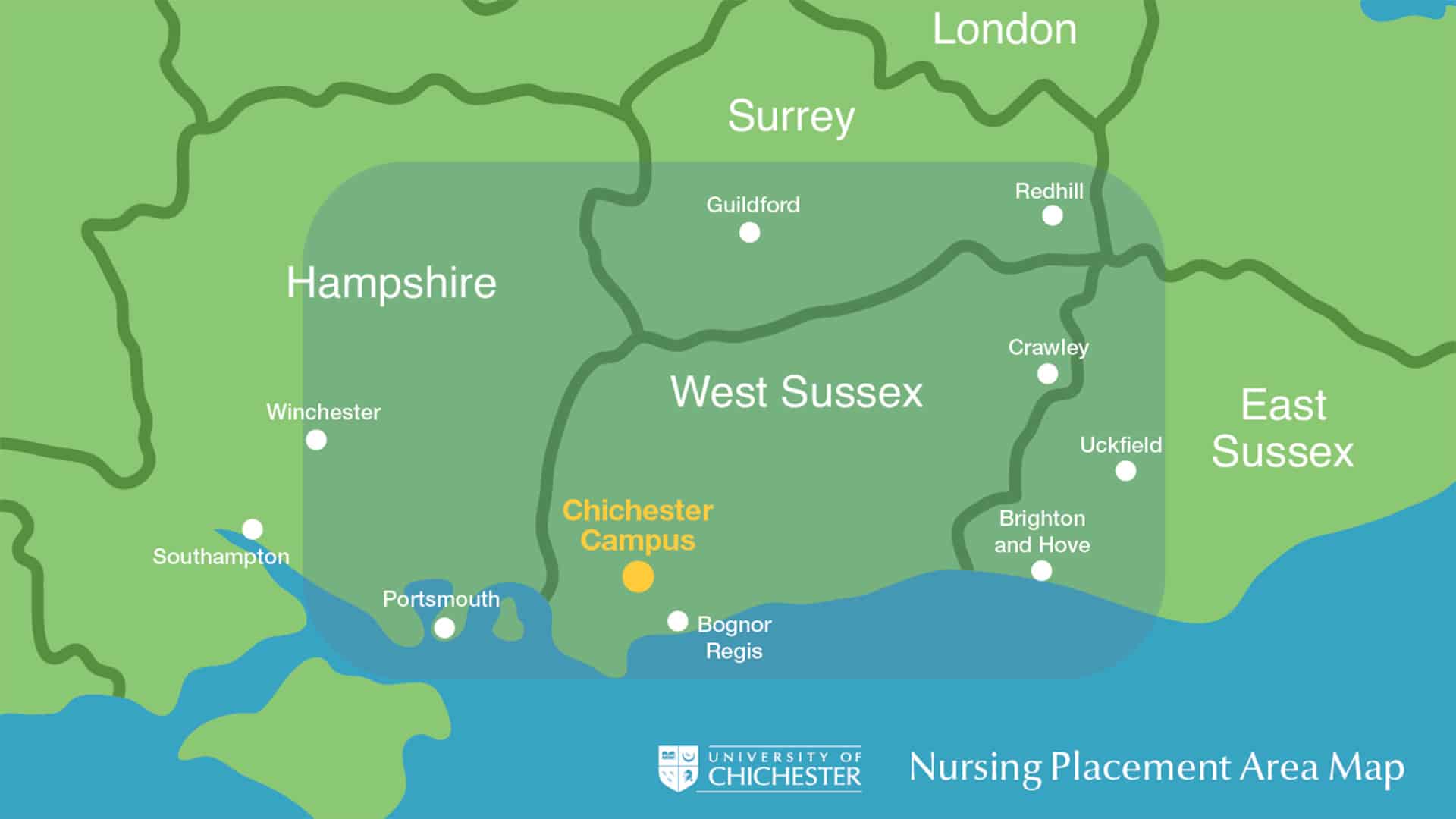
Please note the map above provides an overview of the placement areas and not an accurate representation. Placement travel time will usually be up to an hour and a half from the Bishop Otter campus.
Careers
Graduate ready for a career in nursing
As a registered nurse, you’ll have a varied and fulfilling career ahead of you.
Graduate ready for a career in healthcare
As a University of Chichester BSc (Hons) Registered Nurse Degree Apprenticeship graduate, you will demonstrate an elevated level of compassionate leadership, excellent digital literacy skills, resilience and evidence-based knowledge which is person-centred and will prepare you to continue your career in a modern-day nursing workforce.
Become a core part of a healthcare team
Registered nurses are a key part of the multidisciplinary teams that care for patients. You will be able to demonstrate an elevated level of compassionate leadership, excellent digital literacy skills, resilience and evidence-based knowledge which is person-centred and will prepare you to enter a modern-day nursing workforce.
Potential careers
As a registered nurse, you can apply for registered nursing roles in the UK across the different clinical settings in primary, secondary, and tertiary care.
Career support
As a University of Chichester graduate, we will provide you with clear guidance for future career choices across the healthcare sector. There will be an opportunity to attend many recruitment fairs with local employers, who will be keen to recruit you.
Course Costs
Your employer will pay your tuition fees to the University, so you will graduate without tuition fee debt.
As an employee, you will receive your salary from your employer and be eligible for employee benefits while you study. You will not be eligible for a student loan.
To find out about any additional costs for this course, please see our Additional Costs page.
Course specific costs
One uniform will be provided but you are likely to require additional uniforms which cost in the region of £30. Discuss with your employer about additional funding.
You will need a pair of suitable, comfortable shoes while on clinical placement and studying in our simulation settings (estimated cost £40- £60).
You will need to purchase some of your own clinical items, for instance a stethoscope and fob watch (estimated cost £30).
You will need to be able to travel to your placement.
You will be required to have a satisfactory enhanced Disclosure Barring Service (DBS) check costing £55, which needs to be paid for before the start of the course. Your employer may be able to pay this for you.
Entry Requirements
Typical offer (individual offers may vary)
You will be required to have the following prior to the course start date:
UCAS
104-120
points
Qualifications
Level 2
GCSE: English Language, Mathematics at C/4 or higher (Functional Skills English and Maths Level 2 Pass are accepted equivalents) and Science at C/4 or higher.
Qualifications
Level 5
FdSc Nursing Associate Qualification
Recognition of Prior Learning (RPL)
Applicants will be considered on an individual basis in line with the University’s Admissions policy and the Nursing and Midwifery Council Standards and requirements.
Additional requirements
- Capability in digital and technological literacy
- Attend a nursing values-based interview
- Satisfactory disclosure and barring service checks (enhanced checks) – completed by employer
- Candidates are required to be employed for a minimum of 30 hours per week to be eligible under the Apprenticeship Funding Rules (Department of Education, 2025)
- Good health and character evidenced through occupational health clearance and confirmation from current employer
- Complete a satisfactory occupational health assessment and criminal records check (disclosure and barring service (DBS)) is required on entering the programme
Interview
Your interview will be conducted online through SAMMI®, a flexible and user-friendly virtual platform. This means you can complete your interview at a time that works best for you within your chosen six-day window.
The interview will follow a Multiple Mini-Interview format, designed to give us a well-rounded view of the skills and qualities you need to become a competent Health Care Practitioner.
For more information on the interview process, please visit our Interviews and Auditions page.
Contextual offers
We believe everyone deserves an equal opportunity to pursue higher education, regardless of their background.
When we receive your application, we consider your personal circumstances and the factors surrounding your achievements to see if you are eligible for a contextual offer. This is an offer with a reduced entry tariff – typically the equivalent of 16 fewer UCAS points (two A-level grades).
Applicants who are predicted to achieve two or more (A-level) grades better than the published typical offer will normally be made the typical offer, rather than a reduced offer. For example, where the predicted grades are BBB, and the published typical offer is BCC, a BCC offer would be made.
Find out more about our contextual offers.
Applying
Applicants for this course are recruited directly by employers, or are already employed by the NHS, private or voluntary organisation.
You can contact our team who can help you find these roles.
You will need to have a role in place before you can undertake the course.