
Overview
Create your pathway to success on our intensive dance and performance programme
Our BA (Hons) Dance and Performance course prepares you for the world of work as a versatile dance artist and performer, as you focus on the practice of contemporary dance performance.
Develop your technical skills with intensive training
With a 70:30 practice-to-theory ratio, this highly-practical course builds your technical foundations through intensive daily classes under the guidance of our expert and active dance practitioners.
Extend your performance skillset
In addition to your daily classes, our specialist performance technique classes allow you to explore a variety of specific aspects of contemporary dance performance and physical conditioning that relate to your own training.
Gain professional experience within a working dance company
In your third year, you will have the opportunity to expand your professional network as you join the 3Fall Dance Company and work with industry-active choreographers to prepare a full evening performance, which you will then tour in theatres and schools across the country.
Areas of focus include:
- Cunningham
- Limon
- Release
- Ballet
- Contact improvisation
- Somatic practices
- Dance styles from styles influenced from other cultural perspectives.
Explore topics that include:
- Choreography
- Body conditioning
- Advanced ballet
- Aerial
- Yoga
- Feldenkrais.
Work with professional choreographers and practitioners
You will work with professional choreographers from both our Dance department and visiting artists to create a mixed bill of work ready to tour to schools and theatres around the country,
Our lecturers and dance tutors are all experienced, professional and practicing choreographers, technique tutors, dance artists and dance science specialists.
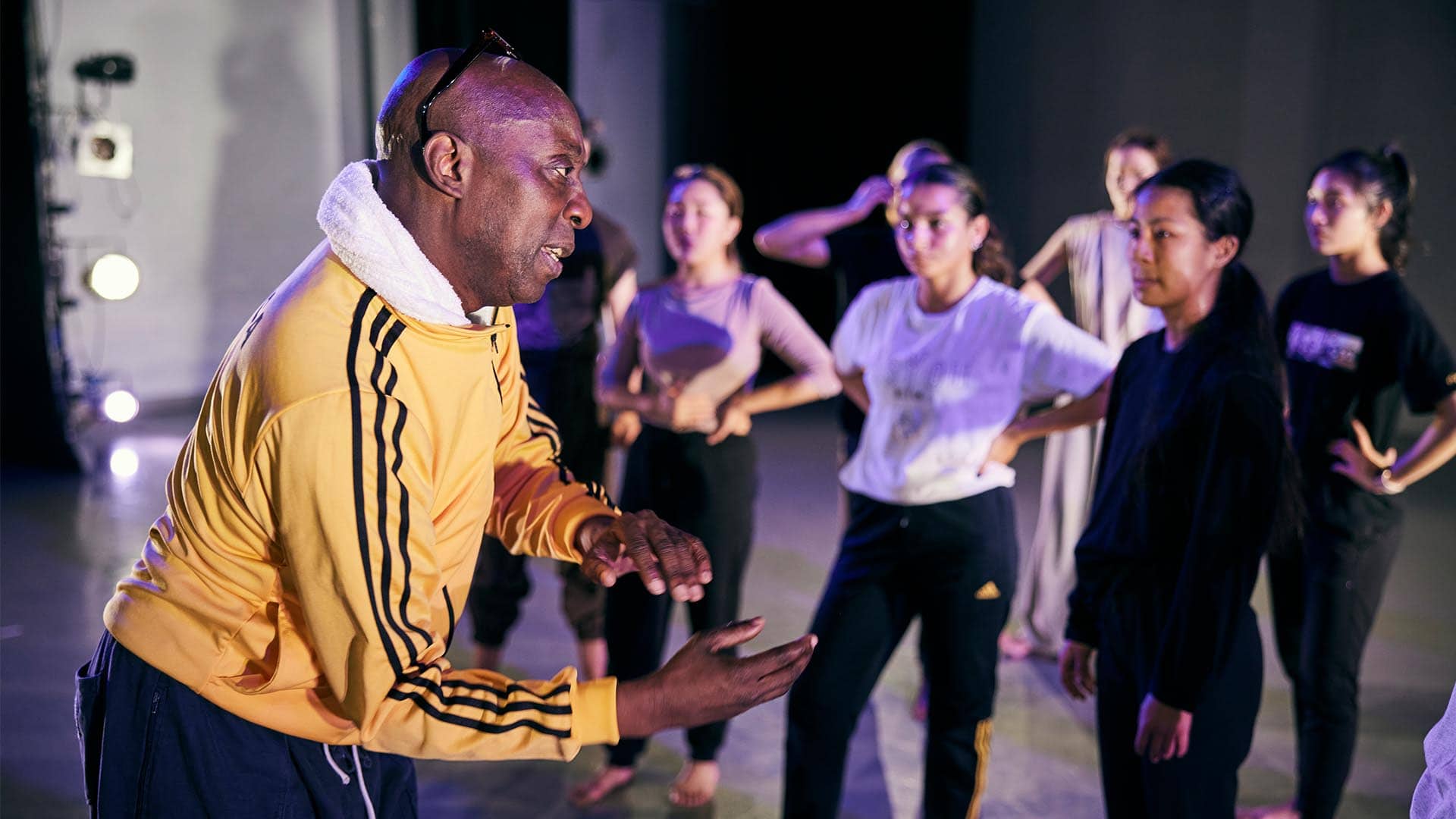
Our tutors approach each class as an opportunity to share their expertise with you to nurture your talent and extend your creativity as they get to know you and your aspirations.
Collaborative and supportive community
Studying and training at the University of Chichester means that you will join our close, collaborative community of dancers, choreographers, writers and researchers.
International exchange opportunities
As part of your dance course, you can take part in an international exchange programme during your second year, as you experience new cultures whilst you continue your dance training.
Prepare for your career
With work placement and study exchange opportunities, this course expands your network of professional contacts and provides you with vital experience within commercial dance spaces that help prepare you for your chosen career within the sector.
The ‘Preparing the Dance Artist for Work’ module helps you plan for your future career as you develop a showreel, a CV, social media presence and your knowledge of auditions and funding in the arts.
On this course you will:
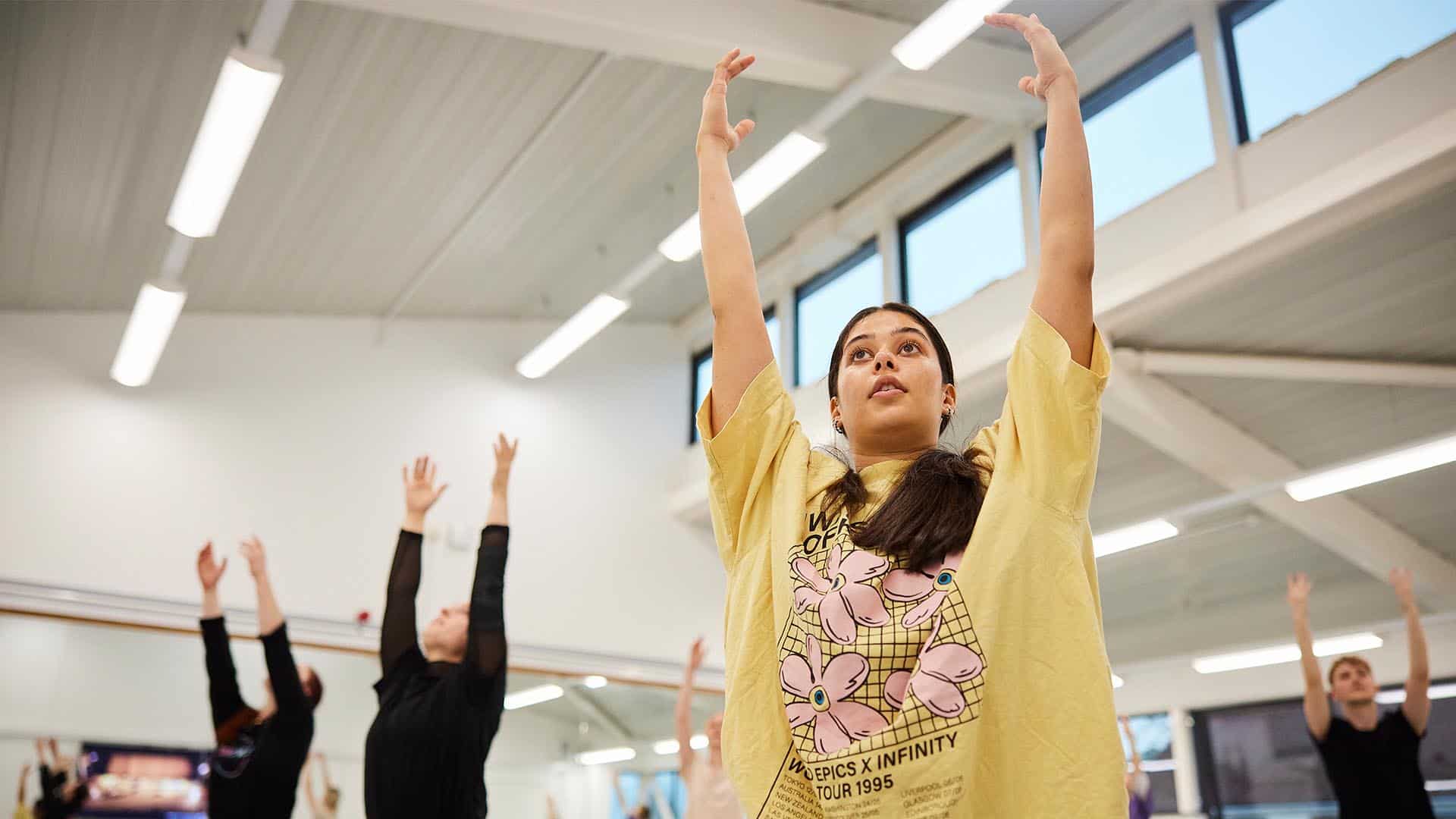
- Develop your technique and performance skills through daily dance classes.
- Gain vital professional experience as part of the 3Fall dance company.
- Extend your practical and theoretical knowledge of dance performance.
- Learn from experienced and sector-active dance practitioners and researchers.
- Join a close dance community and work with dance students from other courses.
The Course
Build your technical skills and professional confidence
Year One
Build your skillset
During your first year, you will gain a solid foundation in dance practice with intensive daily technique classes and physical conditioning sessions to improve your performance skills, as well as weekly choreography sessions that explore composition and help you find your creative voice.
Year Two
Begin to specialise
In your second year, you will continue to develop your performance skills as you begin to specialise in areas such as repertory, scenography, aerial and improvisation.
Preparing the Dance Artist for Work
In addition, you will begin to you plan for your future career in dance.
You will develop strategies to connect with dance companies and organisations, internships and graduate apprenticeships.
You will also gain access to guidance on self-employment, insurance and DBS requirements through workshops and individual research projects.
Year Three
Expand your horizons
In your third year, you can specialise further by choosing modules on dance practice and performance that relate directly to careers in performance, choreography, dance movement psychotherapy, teaching and interdisciplinary arts projects.
3Fall Dance Company
Your 3Fall company experience is central to your third year and reflects professional dance company approaches. You will work intensively with choreographers and rehearsal directors to create a full bill of work for touring to a range of venues, delivering workshops in education and community settings as you learn to become a valued member of a company.
Robbie
BA (Hons) Dance and Performance student
The Dance and Performance course is a great way to widen your dance knowledge and improve your technical abilities. The course is demanding; physically and mentally but in your lessons, you learn to channel your energy to make sure you can perform the same at the beginning and the end of each day. The teachers are really supportive and understand that everyone has different strengths. Before coming to Chichester, I had never done ballet before; I was worried that I would struggle and not be able to keep up with everyone else, but the teachers have really helped me and pushed me the right amount so that I feel more confident and comfortable in class.
Modules
This list is indicative and subject to change.
- Dance Techniques 1
- Examining Contemporary Dance History
- Choreography: Devising and Performance
- Dance Portfolio
Dance Techniques 1
This module supports you in developing foundational dance technique through regular participation in style based and experiential training.
Through structured classes, you will refine core technical skills including alignment, coordination, spatial awareness, musicality, and movement memory, while cultivating an embodied understanding of safe and sustainable working practices reflective of the professional dance sector.
Emphasis is placed on developing clarity, efficiency, and confidence in movement through repeated practice, guided correction, and exploratory tasks.
You will engage in a range of technical approaches, including floor work, ballet barre, centre practice, travelling sequences, and improvisational methods.
These experiences enable you to develop kinaesthetic awareness, accuracy in timing, and the ability to respond to both set material and creative stimuli.
Key components of dance fitness such as strength, stamina, core stability, and body placement, are embedded throughout the module to support your physical readiness and technical progression.
Alongside practical training, you will be encouraged to apply your developing knowledge of warm‑up and cool-down strategies, anatomical principles, and personal physical awareness to ensure safe engagement in all classes.
By the end of the module, you will be able to demonstrate increased technical proficiency, articulate informed approaches to safe practice, and take greater responsibility for preparing your body for the demands of university level dance study.
Examining Contemporary Dance History
This module introduces you to the histories, contexts, and practices that shape contemporary dance, with a particular emphasis on the UK contemporary dance landscape. It recognises that contemporary dance is not a singular or unified form but comprises diverse practices, histories, and voices.
You will explore a chosen (by the tutor) area of focus – which may be a practitioner, a dance work, or a dance style – and investigate it through both theoretical and practical approaches. Theoretical study will require you to situate the chosen focus within relevant cultural, political, social, and artistic contexts, with particular attention to its relationship to UK contemporary dance practice.
The module also introduces perspectives that engage with questions of representation, including decolonial approaches. You will be encouraged to recognise how contemporary dance histories and practices are shaped by global contexts, and to acknowledge the breadth of practices and voices that sit both within and beyond dominant narratives of contemporary dance.
Alongside critical study, you will engage in practice-based exploration, allowing you to experience, interpret, or respond to the chosen focus through embodied enquiry. This integrated approach supports the development of understanding across both analytical and experiential dimensions of dance.
Choreography: Devising and Performance
The aim of this module is to introduce a range of choreographic techniques and performance skills through a progressive journey.
Experiential learning provides opportunities to engage creatively with improvisation, task-based exploration and compositional approaches as key methods for dance-making.
Initially, tutor-led processes support the development of creative thinking and performance skills, positioning you as a ‘thinking dancer’ within a collective process.
As the module progresses, you will work both independently and collaboratively to develop original choreographic work for public performances.
Through engagement with contextual research and contemporary practices, you will begin to make connections between studio practice and the wider dance landscape.
You will be encouraged to develop as a reflective practitioner, engaging in self and peer appraisal to support your ongoing creative and professional development.
Dance Portfolio
This module introduces you to a range of practices and approaches that support dance study and professional development.
You will explore different areas of dance practice, including creative, technical, and contextual aspects, to help you build a broad understanding of the field.
You will engage with a selection of topics drawn from current dance practice, which may include areas such as dance and technology, aerial practice, dance production (including lighting, sound, and stage management) and health and wellbeing.
Through practical sessions, workshops, and guided activities, you will develop foundational skills and begin to understand how different approaches to dance practice can inform your learning.
You will be encouraged to reflect on your experiences, communicate your ideas, and explore how your learning connects across different modules.
The overall aim is to help you build confidence, curiosity, and independence as a learner, while beginning to identify your developing interests within dance.
- Dance Techniques 2
- Researching Dance Practice
- Practice, Performance and Research
- Preparing the Dance Artist for Work
- Repertory Optional
- Aerial Dance Harness Optional
Dance Techniques 2
This module extends the technical, stylistic and reflective foundations established at Level 4, enabling you to develop greater complexity, precision and artistry in contemporary dance and supplementary styles such as ballet. You will deepen your ability to integrate movement complexity with qualitative interpretation, applying technical knowledge with increasing autonomy and professional awareness.
You will be guided to refine your working practices in line with expectations of the professional dance sector, demonstrating responsibility for your physical preparation, safe practice and ongoing technical development. Through more demanding material, you will strengthen your capacity to analyse, problem‑solve and make informed artistic choices in performance.
The curriculum builds on Level 4 by introducing greater technical and qualitative complexity across contemporary dance and ballet. Classes focus on developing advanced movement memory, nuanced musicality, dynamic variation, and sophisticated use of space. You will work with more challenging sequences, extended phrases and improvisational strategies that require deeper embodiment, responsiveness and creative problem‑solving.
Qualitative interpretation is explored through imagery, dynamic contrast, and stylistic specificity, supporting your ability to synthesise action, intention and performance presence. Contextual understanding of dance styles and approaches to technique is developed through practice, discussion, and feedback, encouraging you to make informed artistic and technical decisions.
Key components of dance fitness are progressed at this level, including strength, stamina, coordination, alignment, and kinaesthetic awareness. You are expected to apply your knowledge of warm‑up, cool‑down, and injury‑aware working with increasing independence, demonstrating safe and effective preparation for daily technique classes.
Researching Dance Practice
This module is designed to prepare you for researching and writing a dissertation in dance at level 6.
This module aims to explore the nature and application of research within a dance context, by introducing you to philosophies that underpin different approaches to research.
You will explore a variety of different research methodologies and methods for theoretical and practice-led research and will consider the wider value of research within dance and artistic practice.
This module will also focus on current debates about 21st century dance practices and artists through consideration and exploration of current dance research practice.
Building on the study skills and knowledge of dance acquired at levels 4 & 5, this module will contribute to future research and specific modules across the programme, namely DAL600 Dance Dissertation Module.
Practice, Performance and Research
This module provides opportunities to broaden your choreographic experience and develop key critical, research and choreographic skills through the development of a devised choreography.
In the module, you will undertake a process of creative enquiry using interdisciplinary approaches in response to the practice of (usually two) tutor identified, case study artists.
These artists might work in the disciplines of dance, art, architecture, literature or sculpture, etc and will be considered as source material for the development of your own production created through researching and applying methods that respond to their approach to form and content, concepts and structures.
Autonomous and collaborative study provide opportunities for you to clarify and translate your ideas into choreographic concerns that embrace complexity and depth.
Learning is enhanced by reflective practice, supported by observation, discussion, and critical appraisal. Attendance and collaborative practice is central success in the module and in addition, you are encouraged to attend dance performances and to perform in the work of peers to further your learning.
Preparing the Dance Artist for Work
This module is designed to develop your understanding of the dance sector as you prepare for a future career in dance.
You will apply your understanding of how contemporary dance practice is structured around the notion of a portfolio career and you will direct the focus of your studies to an area that is relevant to your skills and career goals.
You will develop strategies for networking with relevant organisations e.g., dance companies, arts centres, and educational institutions (as appropriate).
You will compile guidance on self-employment, insurance, DBS applications, funding and/or grant applications that will form part of your own personal development plan.
Repertory
OptionalThis module aims to provide you with an opportunity to expand technical and interpretative skills in dance performance, through the creation and production of a repertory work directed by a professional choreographer.
Aerial Dance Harness
OptionalThis module provides an introduction to moving and devising choreography with dance harness.
It aims to familiarise you with the equipment used and safe practice, before developing a range of introductory techniques such as low flying, partner work (ground and air) and counterbalance.
Aerial Dance Harness aims to develop your improvisation techniques as a tool within exploration of new ways of moving and the devising process.
You will engage with a series of practical workshops that introduce dance harness techniques.
Focusing on developing connections between aerial dance and contemporary dance, workshops will be framed in a way that invites curiosity and exploration through improvisation.
- Dissertation Project
- Dance Techniques 3
- Applied Dance: Community Production & Administration Optional
- Choreographic Projects Optional
- Embodied Approaches: Motor Learning and Dance Movement Psychotherapy Optional
Dissertation Project
The Dissertation Project is the culmination of Level 6 study and provides you with the opportunity to undertake a substantial, independent body of work that reflects your artistic interests, academic strengths and emerging professional identity. The module supports sustained engagement with rigorous research, critical reflection and the integration of theory and/or practice, appropriate to honours level undergraduate study.
You must select one of two (BA Dance Education and Teaching; BA Dance Studies ‘top up’) or three (BA Dance and Performance; BA Dance Studies ‘top up’ if Dance and Performance route) pathways, each should be framed as a coherent research enquiry and underpinned by scholarly and reflective approaches:
Performance Strand* (option only available to BA Dance and Performance and BA Dance Studies (Int route) ‘Top Up’ if choosing Dance and Performance route*):
This pathway combines professional performance experience with critical reflection and written research. You will work within 3Fall, the University’s touring dance company, engaging in rehearsal, performance, touring and associated creative professional roles. Performance practice is integrated with scholarly enquiry and reflective analysis that is demonstrated in the writing of an academic reflective paper.
Choreographic Research Strand:
This pathway centres on the creation and presentation of an original choreographic work. You will undertake practice-based research supported by contextual and critical writing that articulates your artistic intentions, influences, methods and outcomes.
Research Strand:
This pathway focuses on an academic investigation into a self-selected topic in dance. Projects may be realised as a fully written dissertation or as a written submission supported by a presentation.
Selection of a Dissertation pathway is made by you in consultation with relevant tutors. You are expected to choose a strand that aligns with your demonstrated engagement and preparedness developed across earlier stages of the programme. If you opt for the Performance or Choreography strands, you will normally have demonstrated sustained engagement with technique, performance and/or choreographic modules earlier in the programme, ensuring you are appropriately prepared for the demands of advanced practice at Level 6.
Across all pathways, the Dissertation is conceived as one sustained research enquiry, demonstrating advanced critical thinking, autonomy, methodological awareness and reflective engagement appropriate to Level 6 undergraduate study.
Depending on your chosen pathway, the dissertation may combine written work with performance, choreography or presentation. Where practice forms a substantive part of the research enquiry, the written submission is correspondingly reduced, while the project continues to be assessed holistically as a single integrated body of work.
Dance Techniques 3
This module consolidates and extends the technical, stylistic and reflective foundations established at Levels 4 and 5, enabling you to demonstrate refined technical precision, stylistic sophistication and mature artistic interpretation in contemporary dance and ballet.
You will work with greater autonomy, applying advanced technical knowledge and performance awareness with the professionalism expected in the dance sector.
You will be supported to develop self‑directed working practices, taking full responsibility for your physical preparation, safe practice and ongoing technical progression.
Through increasingly demanding material, you will strengthen your capacity to retain, analyse and reproduce complex sequences, solve movement problems independently, and make informed, nuanced artistic choices in performance.
The curriculum introduces heightened technical and qualitative complexity, requiring you to work with extended phrases, rapid right/left translation, layered coordination, and sophisticated use of musicality, weight and dynamic contrast.
You will engage with material that demands advanced movement memory, responsiveness and the ability to integrate action, intention and performance presence with professional consistency.
Qualitative interpretation is deepened through exploration of imagery, dynamic interplay and stylistic specificity, supporting your ability to synthesise technical clarity with expressive and interpretative depth.
Contextual understanding of dance styles and approaches to technique is expanded through practice, discussion and critical reflection, enabling you to make autonomous and well‑reasoned artistic and technical decisions.
Key components of dance fitness are developed to an advanced level, including strength, stamina, coordination, alignment and kinaesthetic intelligence.
You are expected to apply your knowledge of warm‑up, cool‑down and injury‑aware working with professional independence, demonstrating safe, sustainable and effective preparation for daily technique classes and long‑term performance practice.
Applied Dance: Community Production & Administration
OptionalThis module acts as a bridge to the professional world, as you undertake a work placement in a dance related role.
This placement may be within dance administration, technical production or work in the community dance sector.
It might also include an ‘in-house’ student-led project that enables you to engage with professional practice through the development and delivery of a contemporary dance project/festival.
During this placement you will be required to apply your own decision-making skills and exercise your own initiative, reflect on and evaluate personal strengths and weaknesses.
Choreographic Projects
OptionalThis module enables you to extend your choreographic practice through the initiation, direction, and production of an original choreographic work.
You will engage in the full choreographic journey, from initial ideas through to public presentation.
The module emphasises the relationship between process and performance, supporting you to develop independent approaches to making.
Planning, problem-solving, critical reflection, and evaluation, enabling you to develop your capacity to research and refine your work with increasing artistic autonomy.
You will be encouraged to develop your personal choreographic voice, explore relationships (eg dance and music, dancers as collaborators) and consider how production elements contribute to your thematic intent.
You will revisit and apply choreographic methodologies and techniques to refine your ideas in works-in-progress.
You will critically analyse your creative process through reflective practice, supported by formative assessments that incorporate self- and peer-review.
The module culminates in a public performance, where you will demonstrate the integration of process, product, and critical reflection.
Embodied Approaches: Motor Learning and Dance Movement Psychotherapy
OptionalThis module addresses two distinct elements – Motor Learning (ML) and Dance Movement Psychotherapy (DMP). Both elements combine theoretical exploration with practical engagement, providing foundational understanding of key Motor Learning and DMP models and approaches to practice.
Motor Learning (ML):
This element of the module will critically explore key facets of motor learning that are responsible for the acquisition and honing of skills and the development of expertise in movement and dance.
The module will explore the interactive role between the dance leader (teacher, choreographer, artistic director, trainer) and the dancer in the process of learning and performing skilled movements.
Motor learning theories and practices will be examined in relation to their potential to enhance the movement learning process, increase the quality of dance practice, and ultimately optimise performance.
Dance Movement Psychotherapy (DMP):
In this element of the module, students will critically examine the theoretical and practical foundations of DMP, a form of creative arts therapy (CAT) widely practised in community and clinical settings.
An integrative approach, with an emphasis on embodying metaphor and the therapeutic use of movement within a ‘boundaried frame’, will be used to explore how these concepts function in real-world therapeutic contexts.
This structured frame, essential to DMP practice, promotes psychological and emotional safety during movement exploration.
Although this module does not equate to a professional qualification in DMP, it provides foundational knowledge that may partially fulfil entry requirements for professional training programmes, such as the MA in Dance Movement Psychotherapy (MADMP).
Across both elements of the module, experiential learning and reflective practice will encourage students to apply DMP and ML principles to applied settings and real-world experiences.
3Fall Placement
Gain vital professional experience in a working dance company
Learn and tour a professional performance
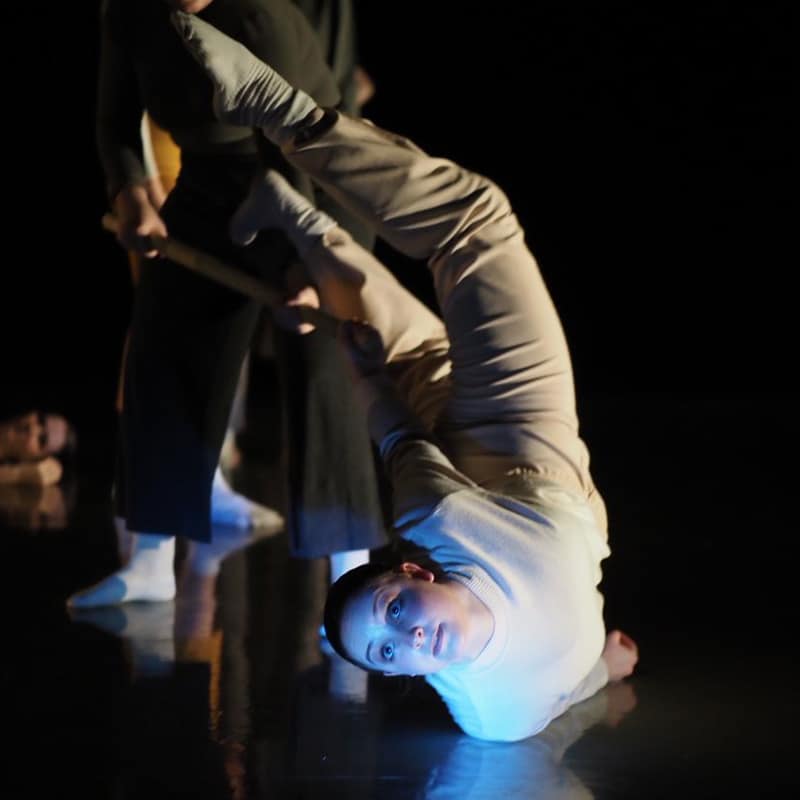
In your third year, you will join the working dance company 3Fall and work with professional choreographers to tour to theatres, schools and colleges and perform a brand-new, professional-standard performance piece.
Develop wider professional skills
In addition, you develop wider skills in arts administration and technical theatre, as you devise marketing materials, take tour bookings and assist in the technical preparations in operating the lighting and sound.
Seize opportunities to teach
You will also gain experience in teaching as you provide educational opportunities to school groups and leading residencies, devise workshops and run technique classes.

Previous choreographers have included:
- James Wilton
- Stuart Waters
- Fillip Van Huffel
- Abi Mortimer
- Aya Kobayashi
- Yael Flexer
- Joe Garbett.
Teaching and Assessment
Feel the support of our experienced and practicing teaching staff
Our expert and experienced dance practitioners get to know you as individual so you can feel more confident to develop your technical skills and explore your creative ideas in a supportive environment.
Outside of scheduled classes you will complete independent study including researching texts, completing individual or group tasks and working on your assignments.
Typical study weeks include:
- Up to eight dance technique classes every week
- Supplemental training practices
- Lectures
- Seminars
- Tutorials
- Laboratory skills sessions
- Studio-based workshops.
Assessment
You will complete a range of practical and contextual assessment tasks such as studio technique class assessments, live performances of your choreography, PowerPoint presentations for modules such as Preparing the Dance Artist for Work and written assignments for Research Methodologies and Independent Study Project.
In addition, you will undertake a shorter final written research project that allows you to focus on an areas of particular interest to you and deepen your knowledge and understanding.
Facilities
Discover our dedicated dance rehearsal, studio, and performance spaces
Bishop Otter campus
Watch our virtual tour of our historic Bishop Otter campus in the heart of Chichester.
Dance Theatre Space
Our 110-seater Arts Council funded Dance Theatre Space provides a dedicated performance space for our dance students.
Dance Studios and Rehearsal Spaces
Our purpose-built studio and rehearsal spaces provide you with dedicated areas to develop your practical skills.
The ShowRoom
Our 250-seat public theatre venue hosts some of the most exciting dance and theatre companies touring the UK.
Gymnasium and sprung floor spaces
Build your confidence using gymnastic equipment with our dedicated gymnasium and sprung floor areas.
Learning Resource Centre
The Learning Resource Centre (LRC) contains the library, a café, IT/teaching rooms and the Support and Information Zone (SIZ).
Library
Our campus library holds more than 200,000 books and over 500,000 eBooks.
Subject-specific librarian
If you have difficulty finding material for an essay, seminar or project, subject librarians will be happy to provide assistance.
Work Placements
Reach out and gain vital experience in a range of professional settings
The Dance Department’s strong links with dance companies and organisations across the country can help you secure successful work experience and placement opportunities.
You will have the opportunity to undertake a work placement with a high-profile dance company, arts organisation or educational setting during your degree. This will help you gain workplace experience and prepare for a range of careers.
Previous students have worked at companies including:
- Motionhouse
- Loop Dance
- Stop Gap
- Jasmin Vardimon
- South East Dance
- Sussex Dance Network
- The Point
- Yorke Dance Project
- One Dance UK
- Scottish Ballet
- National Dance Company of Wales
- Pavilion Dance South West
- Far Flung Dance Theatre.
In your third year you’ll be in our 3Fall Dance Company, which operates as a work-based learning company, and will give you unique opportunities to perform in theatres, schools and colleges.
International Exchange
See our opportunities for incoming and outgoing international study
Whether you are considering studying Dance here and want to take either a semester or year out to study abroad, or if you are currently studying at a university which has a partnership with the University of Chichester – engaging in an international exchange study programme enriches and broadens your educational experiences.
Outgoing students
As a Dance student at the University of Chichester, you will have the opportunity to study at one of our partner institutions in your second year of study.
Students who have undertaken this in the past have found it to be an amazing experience to broaden their dance horizons, a great opportunity to meet new people, undertake further travelling and to immerse themselves within a new culture.
See our Outgoing Exchanges page for more information.
Incoming students
Coming to study Dance at the University of Chichester, you will be welcomed into our community of dancers and will be surrounded by creativity and cultural exchange opportunities. The city of Chichester is a beautiful and historic place for you to get to know.
You are also close to the lively cities of Brighton, Portsmouth and Southampton, as well as a train journey from London.
See our Incoming Exchanges page for more information.
Ellie and Tara
Dance graduates
The exchange to Toronto was the best opportunity we both ever could have asked for. Toronto is an incredible and vibrant city and we are both grateful that we could call it home for a year. In summary, the exchange enabled us to meet amazing people that we can both call friends for life; as well as people that provide connections for future endeavours. As dance students, the exchange allowed us to try new techniques and classes that widened our understanding of contemporary dance, as well as giving us the chance to work with new Professors – that were extremely insightful and inspirational. In addition to exploring Toronto, we both chose to travel further around North America, mainly including the West of Canada and the USA, we found that this adventure was a perfect way to conclude our year abroad.
Graduate Success
Join our community of successful alumni
Previous dance graduates have moved into different areas of performance, teaching, administration, postgraduate study and research. This shows the range of careers available to you when you graduate.
Some graduates have become community dance artists, creating their own companies such as Doodle Dance or working with diverse groups including CAT groups, youth dance, special educational needs and disabilities (SEND) and the elderly.
Some of recent graduate success stories include:
- Kayleigh: Kayleigh is currently an independent dance artist and choreographer. Her company, Chhaya Collective, produces some beautiful work that explores the relationships between artists in the UK and India. Kayleigh returned to Chichester to make a work on 3Fall Dance Company for the 2020 tour.
- Andy: Went on to complete his PGCE, has taught dance in several schools in Kent and is now the Lead Dance Studies Teacher at the Royal Ballet.
- Jen and Joe: Set up aKa Dance Theatre Company in 2014. Joe has since returned to Chichester to make works on both 3Fall Dance Company and Hive Dance Collective.
- Charlotte: Undertook the JV2 training with Jasmin Vardimon and then joined Motionhouse.
Careers
Open up your future career options
Our BA (Hons) Dance and Performance degree has built-in career preparation to support your journey into a range of careers across the dance industry.
You could become a:
- Dance performer
- Community dance practitioner
- Independent dance artist (performer, choreographer)
- Dance company education officer
- Postgraduate student and researcher.
Further study
You could choose to continue your studies at postgraduate level.
University of Chichester alumni who have completed a full undergraduate degree at the University will receive a 15% discount on their postgraduate fees.
Course Costs
Course Fees 2027/28
UK fee
£10,050
International fee
£17,354
EU/EEA Fee Reduction Scholarship
EU/EEA students automatically pay the equivalent of UK fees via the EU/EEA Fee Reduction Scholarship
For further details about fees, please see our Tuition Fee page.
For further details about international scholarships, please see our Scholarships page.
To find out about any additional costs on this course, please see our Additional Costs page.
Entry Requirements
Typical offers (individual offers may vary):
UCAS
104
tariff points from A levels or combination with Extended Project / BTEC / Cambridge Technical.
A Levels
BCC
BTEC
DMM
IB
28 points
IELTS
6.0
with no element lower than 5.5.
Auditions
You will participate in a dance audition (two and a half hour practical) which is designed to assess your potential to respond both technically and expressively. You will also complete an interview where you can showcase your interest and training or experience in dance. Find out more about this process below.
A successful audition at the university may result in an unconditional offer.
Auditions and Interviews
Everything you need to know
Auditions and interviews usually run from November until March. Our dance auditions are designed to support you to showcase your skills and passion for dance in a friendly and creative environment.
We promote an open and friendly environment so that you can enjoy your experience and feel a sense of worth and achievement from the audition process itself.
We aim to engage you in a genuine dialogue during your audition process. The audition is a chance for you to get to know us here at the University of Chichester Dance Department and for us to get a clear understanding of who you are, what you need and how we can best prepare you for your degree.
We judge you on your skills, your potential and your personality, not your background.
You will dance alongside fellow applicants in a 90-minute high-energy contemporary dance class, designed to assess your potential to respond both technically and expressively. The practical audition is designed to mirror a first-year experience so you will also take part in a tutor-led contemporary technique class and a creative task exploration.We are looking for your potential for contemporary dance study (technique and creative practice) and how you work with others on practical tasks. We understand that you may feel nervous about dancing in front of an audition panel and will do our best to put you at ease so that you can perform to the best of your ability.
Please wear dance clothes that you can easily move in. For example, tights, leggings or dance trousers with a leotard or fitted top. You will dance in bare feet for your contemporary dance and creative session.
We like our students to be enthusiastic, excited about studying contemporary dance, and prepared to have a go even if something is challenging. Please don’t worry about any aspect of the practical audition and remember that our students come from a range of dance backgrounds for all our courses. We do not expect perfection and are looking for your potential.
You will also attend an interview with a member of the University of Chichester dance team for where you can discuss your training or experience in dance and specific areas that interest you.
You will be interviewed in pairs or threes. You will be asked to talk about your experience and interest in dance and why you wish to study dance. This interview format is similar to the tutorials and seminar-based activities you will experience at the University, so you are encouraged to discuss ideas with each other. We offer a range of courses, so we are likely to ask about why you have selected this specific course.
We want to see a student who is genuinely interested in studying contemporary dance and is prepared to move beyond dance practice as a hobby. We like to hear about the professionals (choreographers, dancers, researchers) who interest and inspire you and your aspirations for the future.
If you are invited to audition, you will receive an email asking you to book your audition date on ChiView. If you are unsuccessful, we will email you to let you know.
You can usually book two or three different days on ChiView at one time. Once these dates are closed ChiView will refresh to show new options. If none of the current dates suit you then you should wait until the dates renew and check again. Dates are released two to three weeks in advance.
Once you have booked your audition or interview you will have access to the relevant documents on ChiView.
Log in to the ChiView portal, click on ‘Events schedule’ and then ‘View details’ to view, download, or print documents telling you how to prepare for your audition and what to expect on the day.
If your situation changes and you can no longer attend your interview date you should cancel your booking in ChiView by visiting your ‘Event Schedule’ and clicking ‘Cancel Attendance’. You also need to inform the admissions team by emailing admissions@chi.ac.uk so we can send you a new audition invitation.
Sometimes if you are viewing your ChiView portal on a phone you will not be able to see the page correctly. If this happens you should try again on another device.
You may need to clear your browser history.
If you are still unable to see the ‘View details’ button, please check that you have successfully booked your audition/interview by clicking ‘respond to interview invitation’.
If all else fails, please email admissions@chi.ac.uk with query and applicant number.
Different courses have different requirements. If you are auditioning for:
- BA (Hons) Dance Aerial and Physical Theatre and BA (Hons) Dance and Performance: you should upload a solo.
- BA (Hons) Dance Education and Teaching and BA (Hons) Dance and Performance: you should complete the written essay and upload a solo.
- BSc (Hons) Dance Science and BA (Hons) Dance: you should complete the dance science essay.
- BSc (Hons) Dance Science and BA (Hons) Dance and Performance: you should complete the dance science essay and upload a solo.
- BSc (Hons) Dance Science and BA (Hons) Dance Aerial and Physical Theatre: you should complete the dance science essay and upload a solo.
- BSc (Hons) Dance Science and BA (Hons) Dance Teaching and Education: you should complete the dance science essay.
In your interview we will discuss which course you are most suited to.
Yes. Email the Admissions Tutor for the course you want to change to and complete the preparation for that course. At your audition please highlight your change of course with a member of staff.
I am interested in Dance Science, but not sure whether I want to do the BSc or the MSci, do I need to decide now?
There are different entrance and progression criteria for the BSc and the MSci programmes. If you meet these criteria you can opt for either course. If you enrol on the MSci from the outset you will be more likely to have your funding guaranteed for the full four years. It is possible to transfer from one programme to the other after you begin your studies, up until commencing your third year.
What if I forget my Health and Injury Questionnaire?
You can send it to us after the audition, although we won’t be able to process your application until we have received everything.
Your audition day will include a practical audition, your interview and any additional tasks you need for your course. You will have the option to attend a campus tour prior to your audition to see the student accommodation, dance and sports facilities and get a sense of the layout of the campus.
Whilst you complete your practical audition your guests can visit our campus canteen, coffee shops or take a wander into the nearby city centre for a coffee.
After the practical audition you will take part in a small-group interview session where you can discuss your passion for dance and ask any questions you may have about the course and university life.
If you have not already uploaded the following items, please bring with you on your audition day:
- a passport-sized photograph of you to help us identify you
- your completed Health and Injury Questionnaire (available on ChiView after you book your audition).
You can park on-site if you buy a pay-and-display ticket but please note that the demand for car park spaces exceeds the spaces available, particularly during term time. For this reason, there are specific parking controls and restrictions to ensure the efficient and effective operation of the University, equity of access and fairness.
There are clearly marked disabled parking bays available at both campuses.
After your audition, we will discuss your application and our decision with the admissions team, who will update our decision on UCAS. We aim to let you know within a few working days of your audition.
- We may offer you a different course: We may offer you a place on a course within the department that is different to the one they applied for. If this is the case, we will speak to you about this at your audition or shortly afterwards. We will explain our reasoning, which will revolve around placing you on the most appropriate course where we think you will thrive.
W505