Full circle moment as composer and lyricist Marc Folan returns to Chichester for musical premiere
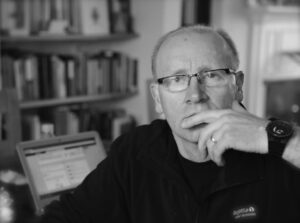
Marc Folan began writing songs as a teenager and has since collaborated on a wide range of musicals performed at venues across the United Kingdom and the United States. His most recent work, Something In The Water, was premiered by the University of Chichester’s Musical Theatre Performance Company in June 2025. The production held particular poignancy, as Marc completed his MA in Composition at ThinkSpace, a partner institution of the University, bringing his creative journey full circle within the same academic community that helped shape his development as a composer.
In this interview, we explore the creative spark behind the show, the challenges of blending musical worlds, and how collaborations at Chichester and beyond have helped shape its future.
When did you compose your first piece of music?
Less than a year after learning to play the guitar as a teenager. I toured Ireland with a band called Night Rider and wrote some of their songs. As for musical theatre, I began writing my first musical in my twenties while performing in an amateur production of My Fair Lady.
When did you study your MA in Composition at ThinkSpace?
I studied from 2019 to 2020. Because of COVID, however, I graduated later, in 2021, at Chichester Cathedral.
How did you discover the initial idea for Something In The Water?
The idea came after I read a BBC News article about John Snow. I was fascinated to learn that The Lancet had only recently apologised for the minimal obituary published at the time of his death. After meeting Paul Mari at a party, I managed to spark his interest in the story — and the project began from there.
How did you hear about the New Musical Summer Project at Chichester Conservatoire?
Through composer friends of mine, who spoke very highly of the programme, the course leader, and the students.
How did you find the sound or musical language for the show?
From the outset, I had a strong sense of the “sound world” I wanted to create. As the show is set in the late 19th century during the Industrial Revolution, I aimed for a traditional musical theatre score with classic orchestration, combined with a percussive, loop-based sound world — something slightly Hans Zimmer–esque. Blending those two elements was the most complex part of the process, as they are not naturally easy to combine.
Was there a particular song that unlocked the rest of the score?
Yes — the opening number, Three Lines. I wrote it first, inspired by the minimal original obituary. It establishes the musical’s world, and many of its musical ideas reappear throughout the score.
What was it like working with the creative team — Charlie Westenra, Neil Metcalfe and Steven Harris?
Honestly, it couldn’t have been better. Everyone shared the same goal: to make the show work as effectively as possible. Each member of the team brought their expertise into the rehearsal room and truly brought the piece to life.
One of my key discoveries was just how crucial scene transitions are. Stephen was a master of shaping them. Charlie was brilliant at interrogating the script with the students, ensuring everyone was clear about the story we were telling. And Neil — my “go-to” musical director — was inspiring throughout. He has an extraordinary ability to adapt to situations and draw the very best from the cast.
What was it like working with Andrew Wright and his students?
Andrew’s organisation of the overall project was faultless. We were kept fully informed and felt completely included throughout the process. The students were fantastic — hardworking, committed, and genuinely invested in the production. When it came to an end, they seemed truly saddened — as were we all.
Tell us about the revised version performed at The Old Operating Theatre in November 2025.
At the University, the visceral impact of 27 performers singing together was extraordinary. However, mounting a similar production in London would require significantly greater financial resources than Paul or I currently have.
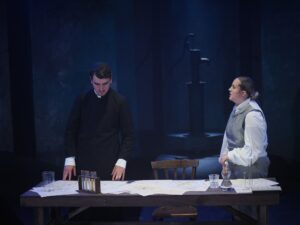
We therefore created a shorter version for The Old Operating Theatre, with a cast of eight, accompanied by piano and cello. Given the venue’s seating, we felt it would be unreasonable to present the full two-hour show, so we reduced it to approximately 70 minutes. While the condensed version worked well, the full-length production remains the more complete and satisfying experience.
How did the Chichester production help develop the show?
We learned an enormous amount during rehearsals. We identified material that needed cutting, realised where additional scenes were required to accommodate costume changes, and discovered that casting women in male roles was, in fact, a brilliant solution.
We were initially apprehensive about choreography but intrigued by its potential. Thanks to Stephen’s expertise, we left feeling both educated and delighted with how it functioned within the piece.
Since returning to London, we have continued refining several scenes and tested revisions in the recent production. I am currently writing a new song for Jane, positioned just before the end of the show.
What are your hopes for the future of Something In The Water?
Drawing on what we have learned from the two productions, we are making further adjustments — including the addition of the new song — and reshaping the show so that it can be staged with a cast of 12 to 14 performers. This would make it a viable option for smaller companies. Ideally, the next step would be a fringe production, allowing a wider public audience to experience the work.
Find out more about Performing Arts at the University of Chichester.