
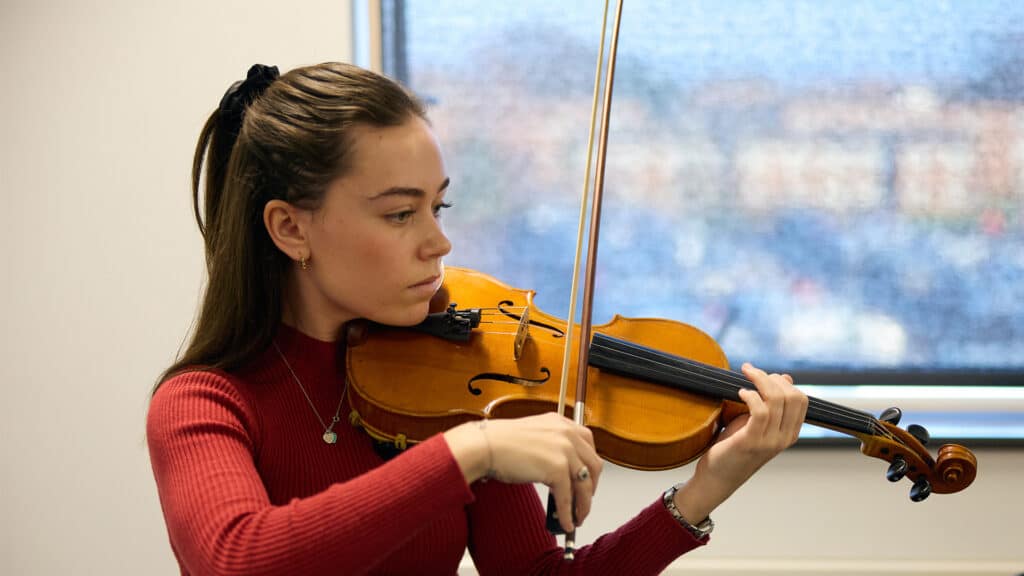
BA (Hons) Music with Teaching
Explore teaching techniques for all ages, discover how music fits into the National Curriculum and learn a new instrument
Explore teaching techniques for all ages, discover how music fits into the National Curriculum and learn a new instrument


100%
positivity for academic
support in Music
National Student Survey 2025
100%
positivity for how well
teaching staff support learning
National Student Survey 2025
Top 30
UK university out of 123 institutions
Guardian University Guide 2026
Overview
This BA (Hons) Music with Teaching degree explores music, instrumental teaching and how to teach a variety of students. You will prepare to teach through practical experience, theoretical study and by learning a new instrument during your course.
This course allows you to explore the technique and mechanics of your own instrument and how it works with various learners, from young children with changing bodies to adults with more established muscular routines.
You will investigate graded examination systems across classical and popular music and explore how music is taught in the National Curriculum for mainstream and special needs children. You will also explore the psychology of learning and teaching, and prepare to support individual students. Every pupil is different so you will learn to prepare, assess, reflect and revise interactions and how teaching material is presented. Your understanding will support positive and pupil-centred teaching, instead of using a reactive approach.
As well as theoretical knowledge you will gain practical teaching experience, prepare assembly presentations and workshops for KS1 and KS2 children, and visit schools to see the different contexts you could work in as a visiting private teacher.
In your final year, you will experience one-to-one and group teaching and teach individual lessons to peers and colleagues. Recordings of these lessons will be used to reflect on your planning, progress and effectiveness in tailoring lessons to the learning needs of individuals.
On this course you will:
- Explore teaching to a range of students.
- Learn a new instrument as a beginner and sit a mock Grade 1 exam.
- Plan a year’s repertoire study.
- Gain practical experience in schools.
- Teach individual and group lessons.
- Develop your teaching and people skills.
- Explore the national music curriculum for various learners.
Why study Music at Chichester?
Teaching and Assessment
How you will learn
You will study using lecturers, seminars, practical classes and workshops. You will learn from a core team of experienced and qualified tutors alongside a wide-ranging team of more than 120 specialist instrumental and vocal teachers.
You will be assessed through a range of assignments including essays, exams, performance and practical work, project work, presentations and seminar discussions.
Rob Murray
Matthew Clarke
Jess Bhatty-Garcia
Saara Sofia Paakko
The Course
What you will study
You will study a selection of core and optional modules in each year. Each module is worth a number of credits and is delivered differently, depending on its content and focus of study.
This list is indicative and subject to change.
Modules
Select a year
Ensemble
You will explore a musical style in your practical work and build confidence in your approach to chamber music and other relevant ensemble styles. You will learn to work as a team in presenting and preparing a performance under the direction of a specialist ensemble coach.
Personal Development
You will be introduced to a range of strategies designed to offer support to the emerging arts practitioner, including models of successful self-development.
This module will help you develop self-awareness in your strengths and weaknesses, and will include workshops on a variety of tools, such as mindfulness, managing stress, nutrition, setting achievable goals, employability and careers, yoga, tai chi and vocal health.
Masterclass
This module develops your basic performance and communication skills and your sense of performance context. You will develop your repertoire, your understanding of style and your skills in preparing for an audition or performance.
You will take part in group performance classes as well as individual tutorials to develop your work, as well as your skills in forming critical judgements of performance.
Musical Grammar
This module will introduce, reintroduce and familiarise you with a range of music theories (traditional, jazz, rock) and aspects of musical structure and notation. Alongside this, you will present and discuss your work, both individually and in groups, enhancing skills in teamwork and presentation and building confidence.
Performance Development
You will work one-on-one with a vocal or instrumental specialist to assess your current repertoire and begin an exploration of new work.
This module provides an overview of skills particular to your individual vocal or instrumental style, and you will explore different approaches to performance.
Technique and Development for the Young Performer
You will be introduced to issues of instrumental pedagogy, ranging from the simple and readable to the complex and specialised, with a particular focus on working with young learners.
The imaginative communication of ideas and the appropriateness of different teaching methods in instrumental or vocal technique will be examined in relation to technical performance skill, in combination with broader issues such as sightreading and memorisation, and children’s physical development.
Ensemble 2
As in year one, this module allows you to explore your potential as a team player in performance. You are encouraged to explore the commercial potential for your performing ensemble, and longer-term planning and repertoire-building strategies will be emphasised in rehearsals and coaching sessions.
Masterclass 2
This module is intended to extend performance and communication skills and to further enhance a sense of performance context. You will continue to develop your current repertoire as a singer or instrumentalist, your understanding of style, and your skill in preparing for an audition or performance.
The importance of communicative performance and of an actively engaging relationship with the listener will be emphasised in group performance classes, and a good standard of critical self-reflection will be encouraged in preparing you for the assessment task.
Music Performance Practice 2
This module will be delivered in workshop/masterclass style sessions, which balance theoretical and practical concepts, addressing aspects associated with the craft of expressive music performance, including the development of expressive facility, the art of responsiveness, using artistic performance devices and developing rapport with an audience.
Working in a complementary way to the performance development in your first year, this module allows you to focus on your expressive palette by deconstructing the concept of expressive performance into a variety of component parts.
You will be guided to consider acoustic and non-acoustic variables such as phrasing, articulation, dynamic range, tonal quality, and use of pace and gesture, in order to most effectively utilise your growing technical and musical facility.
Performance Development 2
In this module you will develop an exploration of musical style in practical work and be encouraged to approach new and more ambitious repertoires.
A more sophisticated relationship to presenting performance and to preparing for audition will be encouraged, while you work under the direction of an individual vocal or instrumental-specialist teacher.
You will be emboldened to take risks in selecting material for study and to question previously held assumptions about the limits of your capacity to achieve as performers.
Psychology of Learning, Teaching and Assessment
This module explores the psychology involved from both the teacher and student perspective during musical learning.
You will gain a general understanding of the historical framework of learning theories and social frameworks within psychology. Specific relationships to musical learning and a student’s concept of musical ability, understanding musical identity and the relationship of the body and instrument are explored.
The understanding of motivation, self- efficacy, self-regulation, mental skills, and cognitive strategies are explored and applied to real-life situations. These form a base of knowledge that can improve current learning and inform the future practice of teaching.
The module also allows you to become a beginner all over again by learning a ‘new’ instrument, recreating the feelings experienced by beginners. Reflections on this experience will inform and shape your approach to teaching.
Various repertoire, aural tests, scales, and sight reading will be included in a broad exploration of assessment, and discussions will cover the pressures or constraints that exams place on students.
Modern and Movie Musicals
OptionalThis module relates a historical overview of the development of the genre to an examination of current trends and practices in musical theatre, both here and in the USA.
A range of models will be used to help you further your understanding of the different cultural contexts in which contemporary musical theatre operates.
The module will also help you to further your understanding of the different cultural and social contexts in which the movie musical operates.
Learning will focus on the way in which media, technology and animated motion picture corporations have altered the way in which movie musicals are received and categorised.
Professional Resilience 2
OptionalA successful career as a performance professional needs to be informed, alongside artistic and communication skills, by an understanding of the nature of personal strengths and weaknesses.
This module will seek to develop this self-awareness and to encourage a confident approach to the world beyond university, enabling a tailored combination of learning and practice approaches which encourages an awareness of individual character and circumstances.
Roots of Jazz to Modern Jazz
OptionalPrevious jazz experience is needed to take this module.
This module will explore the roots of jazz, primarily focusing on the development of jazz between 1890 and 1930 and critically analysing the social, political and cultural context in New Orleans.
The module will also examine the music and musicians that helped to create jazz and will consider the relevance of early jazz with regards to contemporary jazz education and performance.
The focus of study will go on to explore important developments in jazz from its birth in New Orleans to the present day. By examining the history of jazz’s inception through to the current developments, you will gain a broad understanding of the major styles and the particular innovators in the field.
Self-Employment and Promotion
OptionalThis module will explore the local and national marketplace for instrumental, vocal or dance teaching, as well as music and musical theatre performance and acting. It will introduce you to a number of different models of successful positioning within it.
A successful career as a professional needs to be informed, alongside performance and communication skills, by an understanding of the nature of self-employment in business, as well as the skills needed to become employed. This module will seek to develop this, and to encourage a confident approach to the world beyond university, enabling a tailored financial, business and career planning which encourages an awareness of local markets and circumstances.
Ensemble 3
In this module, you will work towards more polished and professional standards in group performance and presentation, and will seek to add to your experience in performing independently off campus.
This module aims to consolidate existing repertoire and to foreground strengths within the group’s overall repertoire. You will undertake this work under the direction of a specialist ensemble coach, as well as taking part in hosting the department’s programme of performance events.
Masterclass 3
This module explores issues of style and technique relevant to your specialist performance context. As you continue to develop your first study repertoire as singers or instrumentalists, yourunderstanding of style, and your skill in preparing for audition or performance are supported through peer observation and learning in the masterclass environment.
The importance of communicative performance and of an actively engaging relationship with the listener will be emphasised in group performance classes, and a good standard of critical self- reflection will be encouraged in preparing you for the assessment task.
One to One and Group Teaching
This module will introduce a range of techniques in structuring lessons, communicating expressive, musical concepts and problem-solving designed to create an exciting and stimulating learning experience for individual learners embarking on the early stages of study.
You will engage in workshop activity designed to explore the potential of strategies and materials that could be used in group teaching contexts, reflecting on relationships between this activity and individual learning.
A student-written and arranged piece played for a varied ensemble made of your peers, alongside additional workshop activity, will provide hands-on experience in gauging a musical level and managing a group.
Personal Study
This module aims to provide you with an opportunity to select an area of study of your choice in performance or individual research.
You may develop a performance programme, research an agreed topic and present your findings in written or presentation form, and will develop this project over an extended period. You can incorporate original composition within your performance or research work if you wish.
Jazz Arranging and Postmodernism
OptionalPrevious jazz experience is needed to take this module.
This module will develop key skills in rearranging standards from the jazz canon. You will look at a number of specific techniques on how to re-create jazz standards in a stylistically inventive manner. The module also allows you to build on your skills to develop a more personalised sound and style within jazz.
You will debate whether Jazz is a style or a process, and be introduced to a variety of models, both practical and theoretical, to recent developments in jazz up to the present day. By exploring the work of such artists as Anthony Braxton and Weather Report, and critical frameworks such as Foucault and Lyotard, Jazz, in this context, will be redefined as a ‘process’, albeit still rooted in a tradition.
You will examine jazz as a form of social transformation, jazz from a postmodern perspective, jazz and issues of gender and jazz as a global phenomenon alongside other related subjects. You will be encouraged to examine and work with the ‘jazz process’, which can be traced back to the very first inception of jazz in New Orleans.
Music Performance Practice 3
OptionalPractice is an activity that consumes most of the time you spend playing or singing, and usually, there is a target or goal associated with the practice activity.
This module is about how we should practise, what we are trying to achieve by practising, and, through more useful and intelligent practice, how to achieve each goal as it comes along.
You will explore how we feel about the music we’re performing, or planning to be able to perform, and how we feel about the often competitive context set by our performance goals. You will learn that we can change how we feel about achieving our goals, and that most of this change will, inevitably, happen through the autodidactic process – through practice.
Devising Musical Theatre
OptionalUnderstanding how music can be used to drive a narrative is a useful skill for any creative musician or musical theatre practitioner. Combining this with the knowledge of creating music in a collaborative and interdisciplinary context enhances the composer and writer/lyricist’s ability to create new and diverse pieces.
By exploring the devising process within the field of musical theatre, you will engage with aspects of creating music and developing a narrative that are rarely explored together, but have produced some of the most iconic works of the 20th and Early 21st Century.
You will examine the relationship between music and the dramatic form within composite artworks in order to develop devising and improvisation skills, and generate successful compositional and theatrical presentations.
Professional Resilience 3
OptionalThis module is designed to help you identify challenges in your journey towards becoming a trained professional, and to provide a variety of tuition and support opportunities for personal development.
You will explore a range of different strategies designed to offer support to the emerging arts practitioner and will be introduced to a number of different models of successful self-development.
A successful career as a performance professional needs to be informed, alongside artistic and communication skills, by an understanding of the nature of personal strengths and weaknesses. This module will seek to develop this self-awareness and to encourage a confident approach to the world beyond university.
Business Project
OptionalThis module will explore examples of business projects in commercial and publicly funded arts. You will also look at the different marketing models and explore an overview of the evolving social and political cultures which have influenced the arts over the last 40 years.
Building on your experience so far, you will be expected to experiment with different approaches to your own marketing and general business strategies to extend your imaginative range within the individual projects.
Facilities
Use industry standard equipment
Chapel
Perform in our on-site Chapel, an acoustically superb performance venue which is a fantastic setting for performances and rehearsals.
Learning Resource Centre
The Learning Resource Centre (LRC) contains the library, a café, IT/teaching rooms and the Support and Information Zone (SIZ).
Library
Our campus library holds more than 200,000 books and over 500,000 eBooks.
Work Placements
Gain experience in industry
You will have the opportunity to put your studies into practice and use the skills you develop on your course during optional work placements and voluntary roles. These opportunities will help improve your confidence, enhance your CV and show employers that you’ve already completed work in industry when you graduate.
You will have the opportunity to take part in:
- Work placements
- Volunteering roles
- Student and graduate internship schemes.
Lecturers
Learn from experienced performers, musicians and tutors
You will be taught by a core team of experienced and highly qualified tutors, alongside a wide-ranging team of more than 60 specialist instrumental and vocal teachers.
As well as supporting student development and the student experience, our staff are active, practicing professional musicians and researchers who regularly perform and record. We have around 140 professional tutors who visit campus regularly throughout the semester to deliver our practical and contextual modules. You will be supported by your one-to-one tutor and your module tutors, as well as your Academic Advisor.
Study Abroad
Explore the opportunity to study part of your course abroad
As a student at the University of Chichester, you can explore opportunities to study abroad during your studies to enrich your educational experiences.
It’s a chance to broaden your horizons, a great opportunity to meet new people, undertake further travelling and to immerse yourself within a new culture.
You will be fully supported throughout the process to help find the right destination and institution for you and your course. We can take you through everything that you will need to consider, from visas to financial support, to ensure you get the best out of your time studying abroad.
Careers
Where you could go after your studies
This BA (Hons) Music with Teaching degree prepares you for a range of careers after you graduate. You will have the opportunity to develop a variety of transferable skills and specific subject knowledge to prepare you for life after university.
Past graduates have secured work in:
- Private instrumental/vocal teachers
- Film, television and radio session musicians
- Teaching at all levels of education
- Music therapy
- Head of Music
- Musical theatre
- Music administration
- Music leaders
- Professional performers: orchestral/opera/pop singers
- Chamber music/band members
- Composers
- Instrumental or vocal peripatetic teachers
Further Study
You could choose to continue your studies at postgraduate level.
Study options at the University of Chichester include:
- MA Music Performance
- MA Music Teaching
- PGCE
- PhD/MPhil
University of Chichester alumni who have completed a full undergraduate degree at the University will receive a 15% discount on their postgraduate fees.
Course Costs
Course Fees 2026/27
UK fee
International fee
EU/EEA Fee Reduction Scholarship
EU/EEA students automatically pay the equivalent of UK fees via the EU/EEA Fee Reduction Scholarship
For further details about fees, please see our Tuition Fees page.
For further details about international scholarships, please see our Scholarships page.
To find out about any additional costs on this course, please see our Additional Costs page.
Scholarships may be available for selected instruments; please enquire with the Head of Music.
Entry Requirements
Typical offers (individual offers may vary):
UCAS
A Levels
BTEC/Cambridge Technical
IB
IELTS
Auditions
You will need to demonstrate your ability in an instrument or voice performance, display musical awareness and showcase your skills during your performance audition. If you have a high level of performance skills you may be considered for a lower academic offer.
A successful audition at the university may result in an unconditional offer.
Interviews and Auditions
Auditions and interviews usually run from January until March/April.
We aim to offer you a genuine dialogue during your application process. This gives you a sense of worth and achievement from the audition process itself; a sense of ownership for you during the process and, ultimately, is an opportunity for us to get a clear understanding of who you are, what you need, and how we can best prepare you for your degree.
We judge you on your skills, your potential and your personality, not your background.
If you are invited to audition you will receive an email asking you to book your audition date on ChiView. If you are unsuccessful we will email you to let you know.
You can usually choose between multiple days on ChiView at one time. If none of the current dates suit you please contact admissions@chi.ac.uk.
Once you have booked your audition, you will be able to access the audition guidance document on ChiView – just log into the ChiView portal, click on ‘Events schedule’ and then ‘View details’ to access the document, which will tell you how to prepare for your audition, what to expect on the day, etc.
If your situation changes and you can no longer attend your audition date, you should cancel your booking in ChiView by visiting your ‘Event Schedule’ and clicking ‘Cancel Attendance’. You also need to inform the admissions team by emailing admissions@chi.ac.uk, so we can send you a new audition invitation.
Sometimes if you are viewing your ChiView portal on a phone you will not be able to see the page correctly. If this happens you should try again on another device.
You may need to clear your browser history.
If you are still unable to see the ‘View details’ button, please check that you have successfully booked your audition by clicking ‘respond to interview invitation’.
If all else fails please email admissions@chi.ac.uk with your query and applicant number.
Once you have booked your audition, please log into the ChiView portal, click on ‘Events schedule’ and then ‘View details’ to access the audition guidance document, which will tell you (amongst other things) what will happen at the audition itself, a basic itinerary of the whole day, parking information, etc.
In brief, there should be an introductory talk by the department, the chance to meet lecturers and other applicants, as well as your opportunity to perform for the audition panel.
After your audition, the panel will discuss your performance and pass our decision onto the admissions team, who will update UCAS and email you with the outcome, whatever it might be.
- We may offer you a different course: We may offer you a place on an alternative, relevant course within the department, rather than offer you the course you applied for. If this is the case, we will state this in your offer letter/email and update your course on UCAS. We will explain our reasoning, which will revolve around placing you on the most appropriate course where we think you will thrive.