
About
The Lab for Self-Efficacy, Performance, and Agency focuses on links between self-belief, agency, and perceived relationships between internal and external processes. The lab specifically aims to further understand the interaction between cognition, metacognition, and aspects of the self as seen through performed tasks across domains. Both quantitative and qualitative research are embraced. For more information about the lab please contact Dr Laura Ritchie on l.ritchie@chi.ac.uk.
Key staff
Professor Laura Ritchie
Professor of Learning and Teaching, National Teaching Fellow Coordinator of Instrumental/ Vocal Teaching and MA Programmes
Dr Benjamin T. Sharpe
Senior Lecturer in Cognitive Psychology, Director of the Human Attention Laboratory, Coordinator for BSc Criminology and Forensic Psychology Programme, and Thematic Cluster Lead for South Coast Doctoral Training Partnership
Other members of LSPA include:
- Andre DaSilva (PhD student investigating cancer patients and singing)
- Matt Welsh (PhD student and research assistant).
PhD completions:
- Dr Nicholas Reynolds (Head of Jazz) The Role of the Spiritual in Jazz Education (2023)
- Dr Christine Tokatlian (Lecturer at the American College in Athens, Greece) Redefining Armenian Musical Identity (2023)
Current projects
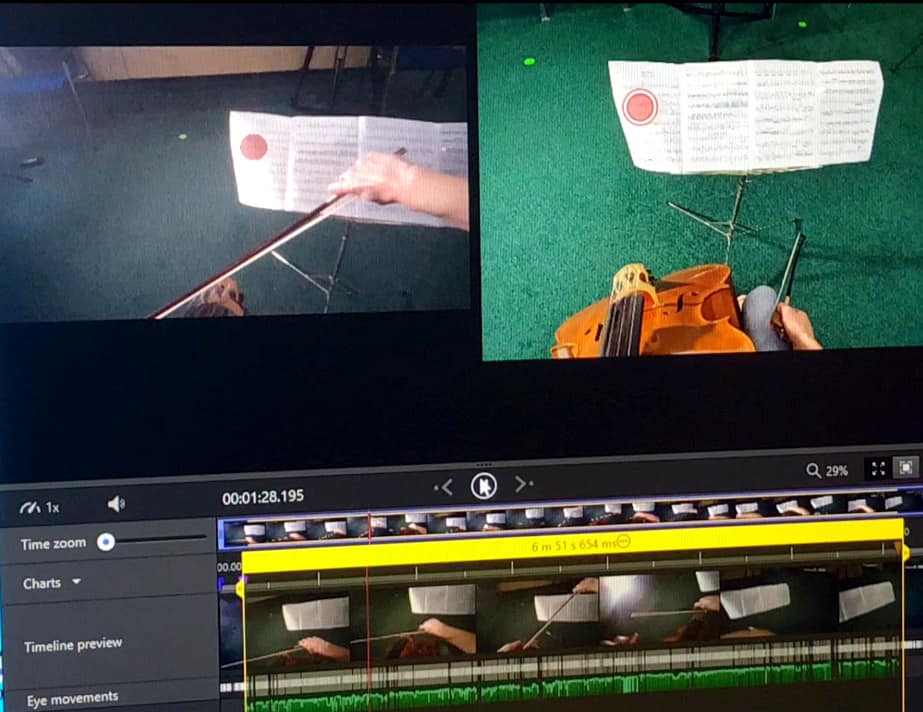
Seeing interactions of self-efficacy, personality, and cognition on task performance with eye tracking
Laura Ritchie, Benjamin T. Sharpe, and Daniel Cervone
This study considers the influence of cognition and perception (of self) on self-efficacy and how cognition and self-efficacy interrelate with metacognition, aspects of personality, and relate to task performance.
Physiological data is collected using a TobiiPro2 mobile eye tracker to explore the relationships of an individual’s self-beliefs, cognitive processing, and their actions.
Self-efficacy and metacognition are measured through a combination of physical responses to performed tasks recorded with an eye tracker, quantitative questionnaire data, and qualitative self-reports.
Performed tasks include musical and physical (sport) performance. The full background and methods can be read on the OSF Wiki. This is a pre-registered project.
Gaze Behaviour of a Cellist: From Sight-Reading to Performance
Laura Ritchie & Benjamin T. Sharpe
This study (manuscript submitted and under review) explores how a musician learns a completely new piece of music, from the first reading to performance.
Learning music has been studied via self-report and via observation, but this study uses physiological measures to support and supplement the musician’s reported experience. The equipment also allows connections between thinking and physical action (performance) to be demonstrated.
The participant wears TobiiPro2 eye tracking glasses, which are initially calibrated by a researcher. The eye tracker video records what the participant sees during the study, and a separate video camera placed in the room will record the entire experimental session. The participant also engages with a talk aloud protocol throughout the performed session. Data from the participant and the eye-tracking glasses are collected across several weeks, as the performer learns the music.
Completed projects
Goals and Self-Efficacy Beliefs During the Initial COVID-19 Lockdown: A Mixed Methods Analysis
Laura Ritchie, Daniel Cervone, Benjamin T. Sharpe
This study aimed to capture how the coronavirus disease 2019 (COVID-19) crisis disrupted and affected individuals’ goal pursuits and self-efficacy beliefs early during the lockdown phase of COVID-19.
Recent publications
- Ritchie, L. (2023). Multisensory Music Performance with Cymatic Images. Music & Science, 6. https://doi.org/10.1177/20592043231159065
- Ritchie, L., & Sharpe, B. T. (2022). Validation and Validity: Self-Efficacy, Metacognition, and Knowledge-and-Appraisal Personality Architecture (KAPA). Psychology, 13(10), 1474-1503. https://www.scirp.org/journal/paperinformation.aspx?paperid=120212
- Ritchie, L., & Sharpe, B. T. (2021). Music student’s approach to the forced use of remote performance assessments. Frontiers in Psychology, 12, 641667. https://www.frontiersin.org/articles/10.3389/fpsyg.2021.641667/full
- Ritchie, L., Cervone, D., & Sharpe, B. T. (2021). Goals and self-efficacy beliefs during the initial COVID-19 lockdown: A mixed methods analysis. Frontiers in Psychology, 11, 559114. https://www.frontiersin.org/articles/10.3389/fpsyg.2020.559114/full