The Chichester Centre for Fairy Tales, Fantasy and Speculative Fiction

The heart of this project is a focus on the fantastic imagination as a creative force both in literature and culture.

The Centre provides a forum where writers, scholars, performers, artists and aficionados can explore world folk narratives, fairy tales, fantasy and speculative fiction in various forms including print, film, and the visual and performing arts.

Meet the team

Postgraduate research projects

Wise-man to Wizard: Tracking the Literary Development of the Wizard

takes a diachronic approach to look at how the wizard has evolved from its linguistic origins as the wise-man into the modern literary figure found today. The project serves to show how the wizard of the contemporary imagination is built upon many reworked representations of the archetype over many historical periods. This includes an exploration of how the various magician, sorcerer and conjurer types that have become amalgamated with the wizard tradition form distinct stages of the wizard’s development. Lastly, the research turns to contemporary depictions of the wizard as hero, rather than its traditional role as advisor, and asks what ramifications this has for the wizard archetype and what it might imply for the next stage of the figure’s development. (Supervisors: Prof Bill Gray, Dr Duncan Salkeld & Dr Amanda Richardson (History))

Hag

, Mitchell’s debut poetry Collection inspired by witches is accompanied by a critical thesis considering the presentation of witches in women’s poetry. Close study of this topic highlights the patriarchal ideology at the foundation of the symbolic order and the motivation behind the designation of the witch as a villain. The critical study focuses on a close analysis of poems by Margaret Atwood, Louise Glück, Audre Lorde, Sylvia Plath and Anne Sexton which use the figure of the witch to reclaim a previously negative image and expose the ideology behind it.

Folklore, Fighting and Fairies

explores the changes in the treatment of fairies by Folklore Society members and how far these reflect wider academic and folkloric trends. It covers the era from the Society’s foundation in 1878 until the eve of WW2. The Society’s journal Folklore is used as the main mouthpiece to exemplify the declining interest in, and more critical treatment of, the fairy figure during this era. The Cottingley Affair and WW1 are explored as turning points between the great Victorian fairy pre-occupation and the post-war benign nursery fairy. The pages of Folklore mirror this pattern of diminution. (Supervisors: Prof Bill Gray and Prof Sue Morgan; Advisor: Prof Jacqueline Simpson)

Demons, Daemons and Frogs: Animal Transformation in Contemporary Narrative

investigates how becoming-animal storytelling locates us in the natural world. The topic will be explored from two perspectives, first an eco-critical analysis of shape-shifting motifs in contemporary young adult literature, and second a pedagogical exploration of the environmental potential of shape-shifting storytelling in a creative writing classroom. Animal transformation tales in folklore will be compared with contemporary re-tellings in writers from Philip Pullman to Ursula le Guin, and both traditional versions and re-tellings will be used as classroom inspiration to explore our changing relationship to the hinge, or boundary, between human and animal. (Supervisors: Prof Bill Gray and Dr Hugh Dunkerley; Advisor: Dr Duncan Reavey)

Imitation as Originality in Modern Fantasy Literature (post-1955)

is tackling the accusation that fantasy fiction is necessarily ‘formulaic’, and exploring the relation of imitation to originality. Her work centres on fantasy fiction published post-1955, arguing that the ‘canon’ of fantasy literature is outdated, with problematic omissions. Authors important to her work include George R.R. Martin, Robin Hobb, Tad Williams, Raymond E. Feist, Guy Gavriel Kay, and Joe Abercrombie, amongst many others. She welcomes any discussions on the aforementioned topics or authors. (Supervisors: Prof Bill Gray and Dr Robert Duggan)

The Art of Storytelling in Emirati Society

features Emirati oral poetry and compares its unique voice with universal themes such as family, tribe, country, love, war, beauty, work and faith, thus enhancing cross-cultural communication. This vibrant tradition expresses vital emotions and teaches ethical conduct during social occasions as a source of communal entertainment and at the same time works to underpin the social hierarchy. This project initiates the preservation of storytelling as a fragile intangible heritage of the Emirates, which has become a bilingual cosmopolitan nation with the result that L1 Gulf Arabic alone is practised only by the oldest members of society. The project will record, transcribe and translate indigenous narratives and poems not yet available in English, gauging to extent to which Bedouins still employ their own version of homo narrans to inform behaviour and enforce cultural norms. It will also outline the challenges faced during the collection of the sources, including negotiating the complex politics of preservation. (Supervisors: Prof Bill Gray and Dr StavroulaVarella; Advisor: Dr. Tanya Al Aghar)

Death, Resurrection and the Flesh of the Imagination: A Critical and Creative Exploration of Cultural Dyslexia

with regards to Nature develops an eco-critical perspective for the reading of portrayals of nature in literature and applies it to the fiction of David Almond. The creative element explores more empowering ways of representing nature in adolescent fiction and explores the origins of folk tales, developing a new myth for the 21st century. Drawing on the atmosphere of the Hebridean Ceilidh House, it also implements a phenomenological response to the ‘more-than-human’ environment as a major influence within the story, linking to ancient pagan tales and myths that formed in response to a reciprocal interaction with animal entities and the Earth. (Supervisors: Prof Bill Gray and Dr Hugh Dunkerley)

A Historical and Literary Analysis of Grain and Bread Motifs in Folk and Fairy Tales

seeks to create a greater understanding of folk and fairy tales through the symbolism of food, with a preliminary focus on grains and domestic baking imagery and expanding to a wider focus on multiple food motifs in fairy tale. It will also map food motifs in folk and fairy tales using a historical compass, connecting these symbols to the availability and production of food stuffs in eras where significant changes in variants affect meaning or interpretation, or detailing where food-centric tales emerge in times of famine or plenty, import or export, etc. The project also aims to provide a catalogue or database for folk and fairy tale scholars in relation to food imagery, categorising which stories include which symbols and motifs, where they change, and possible historical influences on specific stories. (Supervisors: Prof Bill Gray & Dr Andrew Teverson (University of Kingston))

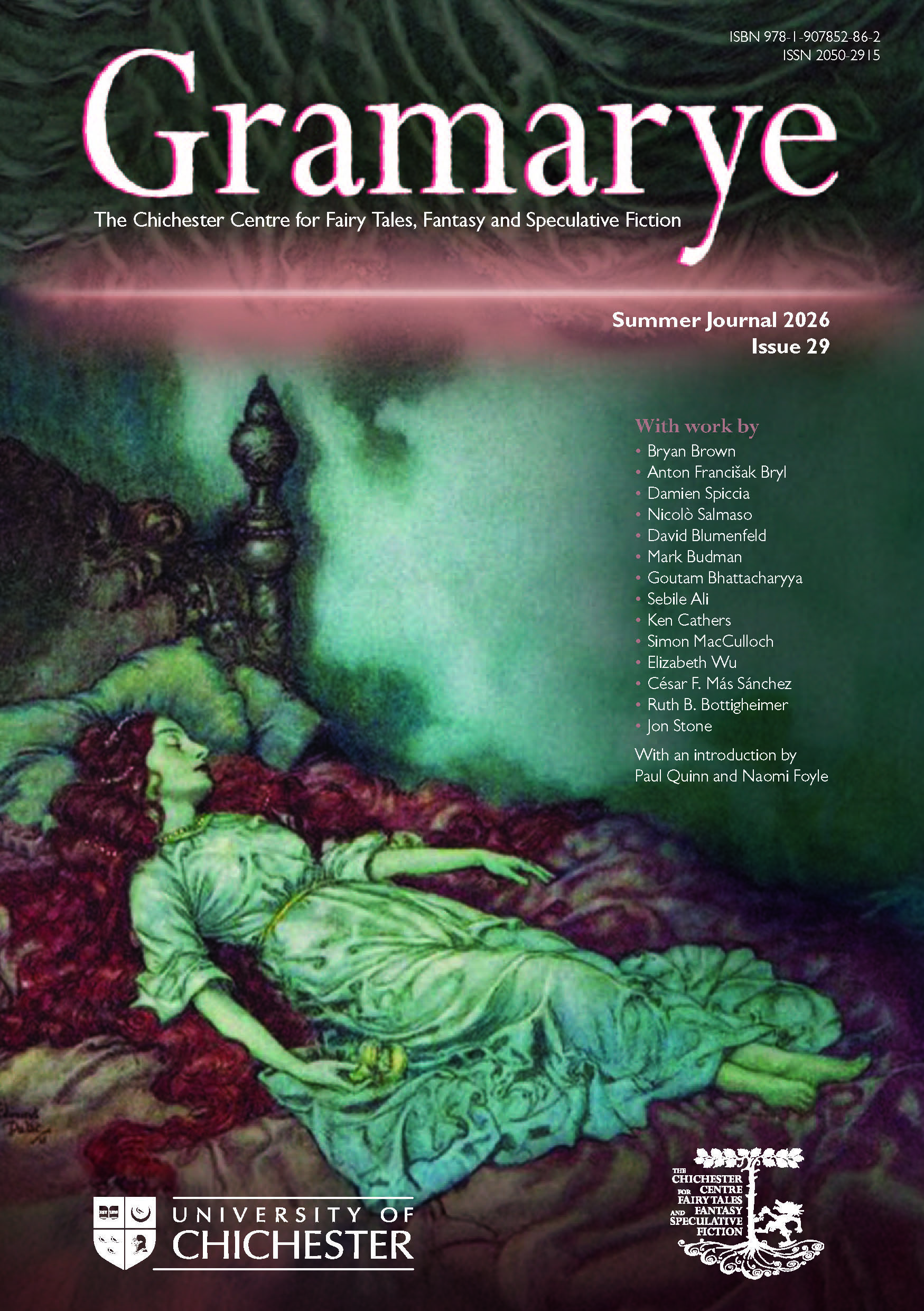
Get the latest issue now

Gramarye, the Centre’s journal, publishes academic articles, creative writing, book reviews and contemporary art.

The printed edition of Gramarye is only available to pre-ordering customers and subscribers. To guarantee your printed copy of future issues, please subscribe.

Limited numbers of back issues are available here.

Scrivener Offer

Gramarye readers are entitled to 20% off Scrivener software, the project management tool for writers. Just visit their website and enter the coupon code ‘SUSSEXCENTRE’.

The Chichester Centre for Fairy Tales, Fantasy and Speculative Fiction seeks articles, book reviews and creative writing relating to literary and historical approaches to fairy tales, fantasy, Gothic, magic realism, science fiction and speculative fiction for Gramarye, its peer-reviewed journal published by the University of Chichester.

Word count guidelines:

  • Long (c.8,000 words) or short (c.3,000 words) articles. Word counts include referencing and citation.
  • Book reviews: c.1,000 words
  • Short fiction – max. 3000 words (one story or several).
  • Poetry – max. four poems to a total of no more than 4 pages/240 lines.

Long poems, traditional forms, flash fictions and experimental creative writing are all equally encouraged. All written submissions must be sent as a single Word .doc or .rtf attachment to the editorial board via the Editorial Assistant Heather Robbins at h.robbins@chi.ac.uk.

We also invite submissions of original artwork (painting, illustration, photography, other digital media, etc), sent as colour image files, along with a brief (300 words max, artist’s statement).

Images may be used as a feature section, or to complement critical and creative texts, as per the editors’ discretion.

Submissions should be accompanied by a separate file with the title, a 100-word abstract, a brief (100 words) biographical note and, for creative work that draws on existing fairy tales, folklore, myth or fantastical traditions, a similarly short statement on why you were drawn to do so.

Relevant colour image files, along with copyright permission, may also be supplied at this stage. If you would like to receive a complimentary e-book of the most recent issue to check content and style, please request one from assistant Heather Robbins (h.robbins@chi.ac.uk).

Only original submissions that are not simultaneously under consideration by another journal will be considered. Unrevised student essays or theses cannot be considered. Submissions must include all quotations, endnotes, and the list of works cited. References should follow the Chicago Manual of Style.

For contributions that include any copyrighted materials, the author must secure written permission (specifying “non-exclusive world rights and electronic rights”) to reproduce them. The author must submit these written permissions with their final manuscript. Permission fees are the responsibility of the author.

Submissions must include all quotations, endnotes, and the list of works cited. References should follow the Chicago Manual of Style.

For contributions that include any copyrighted materials, the author must secure written permission (specifying “non-exclusive world rights and electronic rights”) to reproduce them. The author must submit these written permissions with their final manuscript. Permission fees are the responsibility of the author.

Explore folklore in Sussex

Download a free interactive map (pdf) of folklore in Sussex and the South Downs, created by The Chichester Centre for Fairy Tales, Fantasy and Speculative Fiction in collaboration with the South Downs National Park. The map is based on Jacqueline Simpson’s ‘Folklore of Sussex‘ and illustrated by Abi Daker.

Please download the maps and open in Acrobat to ensure the document works properly on your machine.

Folklore Map Interactive (A3 printable/searchable version): Zoom in and click on the map icons to be taken to the relevant stories, or click on stories to be taken to their place on the map.

Folklore map (Pop-up text version): Zoom in and click on the map icons to see pop-up stories.

This work is licensed under a Creative Commons Attribution-NoDerivatives 4.0 International License.

Hear from the centre

This list is used to facilitate interdisciplinary discussion of fairy tales, fantasy fiction and speculative fiction. Contributions may include:

  • News about conference, events and relevant publications
  • Calls for papers or submissions
  • Research enquiries
  • Other announcements

Get in touch

Email the Chichester Centre for Fairy Tales, Fantasy and Speculative Fiction on info@sussexfolktalecentre.org or speak to our Centre Assistant Heather Robbins on h.robbins@chi.ac.uk.